

Four Years.
One System.
The Dolphins Let Go. So Did the Fullback.
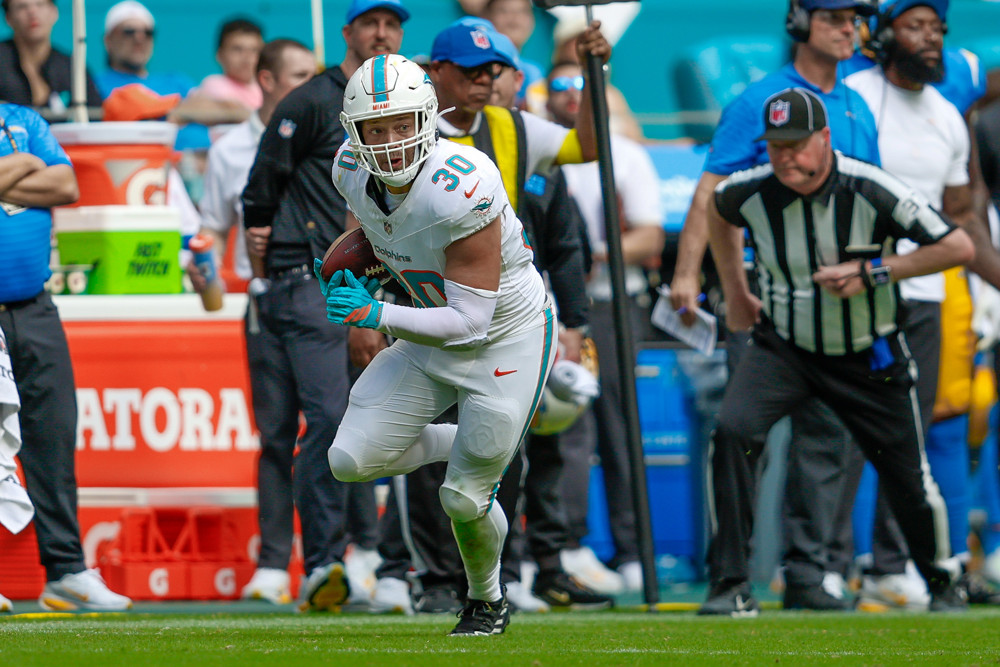
Miami fired Mike McDaniel after the 2025 season. The Dolphins cleared cap, released veterans, and moved on. Alec Ingold was part of that clearing. Discussions on a new deal broke down, and he was cut outright in early March. Standard roster management. Nothing personal.
For a Chargers offense in the midst of a scheme transition, this is a no-brainer signing. Ingold was in the building on McDaniel’s first day in Miami. He signed as a free agent in March 2022, the same week McDaniel was introduced as head coach. He was there for the first team meeting, the first training camp install, the first game in McDaniel’s version of the Shanahan system. Four seasons later, both of them are on the market at the same time. McDaniel landed in Los Angeles. Ingold is waiting to see where the phone rings.
If you want to understand why this signing deserves a dedicated entry in the Individual Decisions series, that paragraph is the reason. This isn’t a generic scheme-fit evaluation. It’s a question about whether the Chargers will reunite a player with the five members of his former coaching staff who are now building an offense in the same city.
The Math Is Quick
The three-budget frame is the lens this series uses on every signing. For Ingold, the analysis resolves faster than any other player we’ll evaluate this offseason. That’s not a knock on the signing. It means none of the three constraints are even close to binding.
Ingold was released outright. The mechanism is identical to what kept the Biadasz signing comp-pick-neutral. Under the CBA, released players don’t count as Compensatory Free Agents gained. The formula doesn’t see them. The Chargers can sign Ingold without touching their comp pick position at all.
On cap and cash, the math is straightforward. Kyle Juszczyk, the template for this role in the Shanahan system and a five-time Pro Bowl selection in San Francisco, makes $5.4 million per year. Ingold was the league’s highest-paid fullback at $4 million APY when he signed his extension in Miami. His next deal will likely come in below that, somewhere in the $2–3.5 million range, given the league-wide trend toward devaluing the position. Total commitment: $6–10 million over two or three years. This is not a budget question. It’s a priority question.
Five Coaches. Four Years. Zero Scouting Required.
Most free agency evaluations involve educated guesswork. A team watches film, runs a player through a physical, calls former coaches, and makes a probabilistic bet on fit. The degree of uncertainty is baked in. The Chargers would be doing none of that with Ingold. They would be calling a player whose entire current coaching staff already knows him personally.
| Coach | LAC 2026 Role | Miami Role with Ingold | Seasons Together |
|---|---|---|---|
| Mike McDaniel | OC / Play-Caller | Head Coach | 4 (2022–25) |
| Chandler Henley | TE Coach | Asst. QB Coach → Sr. Asst. → Run Game Spec. | 4 (2022–25) |
| Butch Barry | OL Coach | Offensive Line Coach | 3 (2023–25) |
| Max McCaffrey | RB Coach | Off. Asst. → RB Coach | 3 (2023–25) |
| Rob Everett | Offensive Asst. | Offensive Asst. | 2 (2024–25) |
That’s not one prior relationship. That’s five coaches with a combined 16 seasons of direct Ingold overlap, all now working inside the same offensive building in Los Angeles. Chandler Henley, now the Chargers’ TE coach, was in Miami for every season of McDaniel’s tenure. Butch Barry coached the offensive line that Ingold blocked in front of for three years. Max McCaffrey developed into Miami’s RB coach while learning the same system Ingold was running. Rob Everett spent two seasons in that room alongside him before making the move west with McDaniel.
There is no scouting process here. There is a phone call.
The template Ingold was built to replicate in Miami is Kyle Juszczyk in San Francisco. When Ingold arrived in 2022, he was explicit about who he studied: “When I first got here and all we were watching was 49ers clips all the time, I was already all over that ‘Juice’ tape.” Juszczyk has been selected to five Pro Bowls running this exact role for Kyle Shanahan. McDaniel was on that 49ers staff from 2017 through 2021, working alongside Shanahan and watching Juszczyk operate every week before he took the Miami job. He knows what the position looks like when it is executed correctly. He has four years of data on whether Ingold can execute it.
One minor connective thread worth noting: both Ingold and Biadasz played at Wisconsin, running zone-heavy concepts under offensive line coach Joe Rudolph. Rob Everett, now the Chargers’ offensive assistant, was Wisconsin’s senior offensive analyst in 2023 before joining McDaniel in Miami. It doesn’t drive the decision. But this coaching staff has more direct familiarity with both Wisconsin and the Miami system than any other staff in the league.
What the Fullback Actually Does Here
In the Shanahan outside zone system, the fullback is not a luxury. It is a structural tool. The pre-snap motion and formation variation that forces defensive alignment errors before the snap (the mechanics that make outside zone work at the NFL level) depend on having a player who can line up credibly in multiple spots. An H-back who can align inline, in the backfield, or out wide is a multiplier on every other play call in the book, because defenses have to communicate around him before the ball is snapped. That communication is exactly what McDaniel wants to disrupt.
Ingold played 40% of Miami’s offensive snaps in the system’s peak season (2022) and roughly 30% of special teams snaps. His role contracted in 2025 as the Dolphins’ offense deteriorated and McDaniel adapted his play-calling around a struggling roster. By the end of his tenure, Ingold was running approximately 20 offensive snaps per game. His 2025 snap volume did not reach PFF’s minimum qualifying threshold for a graded position ranking. That is a function of role design inside a broken offense, not a performance decline worth weighting heavily when projecting his fit in a healthy system in LA.
His career receiving numbers are modest but consistent. 75 receptions across six NFL seasons, an 82.4% catch rate, and 8.5 yards per reception. At the position, those are not throwaway numbers. The fullback in this scheme is not expected to generate yards after contact or create on broken plays. He is asked to catch the ball cleanly when it is thrown to him as a safety valve, a designed flat, or a wheel option. Ingold catches it. That matters for a quarterback’s comfort in the role. Justin Herbert will have enough adjustments to make in year one of this offense without worrying about whether the fullback will put a catchable ball on the turf.
What This Decision Actually Tells Us
The case resolves simply. The question is whether McDaniel still needs the position.
The budget math is clean. Ingold was released outright, so the comp pick formula doesn’t see him. His contract will cost somewhere between $6 and $10 million over two or three years, a rounding error against the Chargers’ remaining cap space. Five members of the current offensive staff know him personally after multiple seasons in Miami. The scouting process is effectively complete before it starts. There is no free agent signing in this entire offseason class that comes with less friction attached.
The harder question is the one McDaniel has to answer internally: is the fullback still a structural piece of his offense, or did it function as one in Miami only because that roster demanded it? In Miami’s best offensive year, Ingold was on the field for four out of every ten offensive snaps. By 2025, that number was closer to two. Is the role evolving as the system matures, or did a deteriorating surrounding cast force McDaniel to use the position less than he intended?
His answer will tell us something concrete about how this offense gets designed around Herbert. If McDaniel believes the fullback remains the most efficient pre-snap communication tool available (the way Shanahan clearly believes it with Juszczyk in San Francisco), then Ingold is essentially already in the building. If McDaniel has concluded that motion by backs and receivers can generate the same defensive stress without a dedicated fullback roster spot, then the Juszczyk template stays in San Francisco and this series moves on to the next decision.
The phone call costs nothing. The signing costs close to nothing. What the Chargers are actually deciding is whether the position still belongs in the offense. What do you think, StormCloud? Is there room in this system for a fullback, or has McDaniel already moved past it?
Data sources: PFF (career receiving grades, run block rankings 2019–20, snap count data), Over the Cap (contract values, Juszczyk APY, Ingold extension terms), Chargers 2026 coaching staff records, Miami Dolphins 2022–25 coaching rosters (via StormCloud coaching database). Coaching overlap data cross-referenced across team staff records by season. Ingold’s 2025 snap volume did not reach PFF’s minimum qualifying threshold for a graded position ranking. All career receiving statistics per PFF/Pro Football Reference.
































I would be surprised if Ingold is not signed and on the final roster.
I agree – it makes too much sense. Ryan actually wanted us to trade for him if he wasn’t cut
I don’t care as long as Scott Matlock is not on the field anymore. Use a fullback, don’t use a fullback. Do your thing McDaniel, just don’t do it with Matlock.
100%