
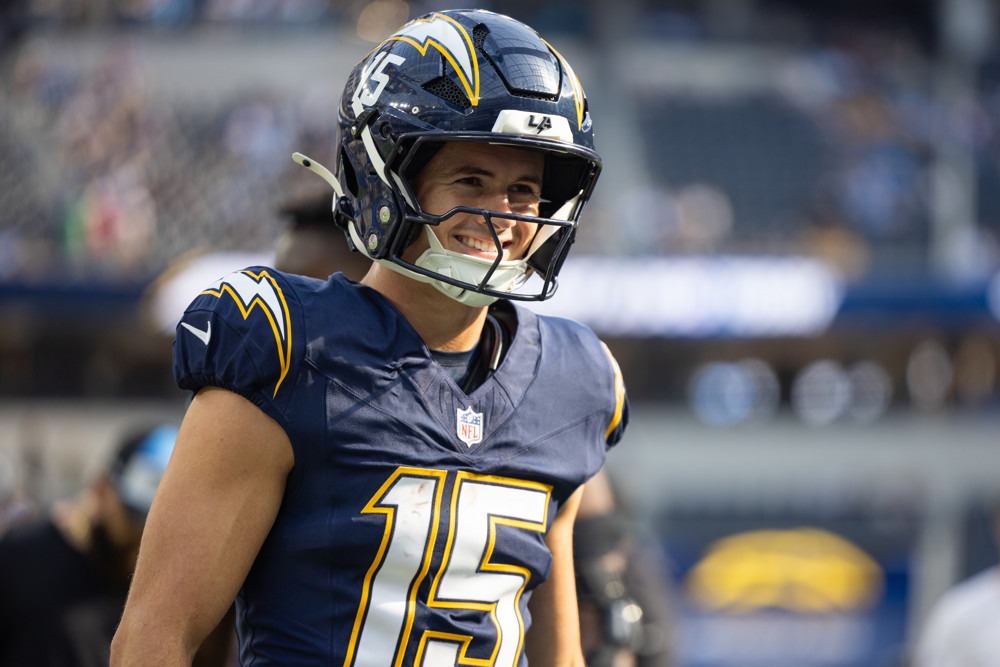

In 2024 Ladd McConkey caught 82 passes on 112 targets for 1,149 yards and seven touchdowns across 16 games, averaging 14.0 yards per reception while functioning as one of the offense’s primary drivers. For a rookie selected in the 2nd round of the draft, that was a simply outstanding return. This electric start obviously got Charger fans excited as to how high the former Georgia Bulldog could climb with more of an established offense around him. However progression is rarely linear and in 2025 Ladd’s production has dropped off a cliff to 66 catches on 106 targets for 789 yards and six touchdowns, with his yards per catch dropping to 12.0.
The bare numbers show a sharp decline from 2024 to 2025 however the context we will go through in this article will aim to explain why the same receiver, in a similar role, produced such different outcomes. The opportunity remained largely intact, in fact he has run 46 more routes than last year, but the offense lost more than 360 receiving yards from essentially the same usage profile. The decline is visible in the box score for everyone to see, but it becomes more pronounced once the analysis moves beyond raw totals and into the efficiency data that tends to stabilize receiver evaluation from one season to the next.
The gap between Ladd’s opportunity and his output is where the story begins. McConkey remained involved, remained targeted, and remained structurally important to the offense. What changed was what each of those targets produced, and understanding that shift requires moving away from totals and toward how individual plays unfolded through both analytics and film study. Let’s start with the advanced metrics.
Ladd’s Efficiency Numbers
Yards per route run provides one of the clearest ways to separate receiver performance from raw volume, and here the difference between seasons is stark. McConkey fell from 2.59 yards per route run in 2024, to 1.40 in 2025. This was a drop large enough to move him from an elite efficiency tier into a far more ordinary one, despite running many of the same routes in similar situations.
EPA per target tells a parallel story. In 2024, McConkey generated +0.577 EPA per target, consistently turning targets into plays that materially improved the offense’s outlook. In 2025, that number dropped to +0.068, reflecting far fewer plays that meaningfully changed the expected outcome of a drive.

When both metrics fall this sharply, the explanation is rarely isolated to one flaw. More often, it reflects a gradual erosion of the conditions that allow efficiency to accumulate — routes finishing with less space, throws arriving later in the progression, and fewer chances to convert timing and leverage into explosive gains.
This Was Not a Catching Problem
Now I know that Ladd has had some high profile drops that have stayed at the forefront of our minds when it comes to his reliability however the data does not support this. If McConkey’s regression were driven by execution at the catch point, it would appear in his reliability metrics which have remained steady. His adjusted catchable target rate, which isolates true drops from uncatchable throws, actually improved slightly from 92.1% in 2024 to 93% in 2025. When the ball arrived within a reasonable catch window, he continued to secure it at an elite rate.
The issue was how often that window existed. McConkey’s catchable ball rate fell from 79.5% to 67%, a sizeable decline that reframes much of his season. Fewer accurate, on-time throws reduce yards after the catch, compress margins on intermediate routes, and eliminate many of the situations where efficiency naturally compounds. This type of regression can read like a receiver problem in traditional statistics while being driven largely by factors outside the receiver’s control.

To get ahead of the expected responses to seeing a large drop in catchable targets; Justin Herbert is not the issue here. His accuracy metrics have remained consistently well above average with only a 0.3% drop in CPOE although this is compounded by the reduction in aDOT vs Sticks. Still, that slight dip does not explain the 12.5% decline in catchable targets. This tells us that the issue lies in either the separation Ladd is able to generate, or the type of targets he was receiving.
Similar Role, Diminished Returns
Crucially, McConkey’s deployment within the offense did not meaningfully change. He remained a predominantly slot-aligned receiver, with his slot rate shifting only from 69.3% to 63.7%, and his average depth of target staying nearly identical at 10.7 yards in 2024 and 10.5 yards in 2025. In fact he was on the field a lot more despite the team shifting to more of a heavy personnel; his snap share increased from 65.7% to 74.5%. Even his target share has only slightly slipped going from 11% in 2024 to 10.3% in 2025, that’s not nearly enough to explain his regression.
However if we go beyond this high level analysis there are areas where his usage has changed. As Daniel Popper of The Athletic brilliantly deduced; Ladd’s targets on quick third down throws have been cut in half:
‘Last season, McConkey was targeted on 25 percent of his third-down routes when Herbert got rid of the ball in 2.5 seconds or less. This season, that rate has dropped to 13.8 percent. Allen, meanwhile, has been targeted 27 times in these situations. No other Chargers player has been targeted more than nine times. Allen has been targeted on 44.3 percent of his third-down routes when Herbert got rid of the ball in 2.5 seconds or less.’
Daniel Popper – The Athletic
What has certainly changed is how he has impacted the game. Ladd is still a threat with the ball in his hands; his yards after catch per reception only marginally declined from 5.2 to 4.7 yards which is still good enough for 8th amongst large volume receivers (over 100 targets). However what has changed is his explosive play rate which has dropped from 13.4% to 7.5%. Explosive gains are the connective tissue between role and efficiency, and when they disappear, overall performance tends to follow even if usage remains stable. Ladd’s 20+ yard target conversion has dropped from 5/9 (55.5%) to 3/14 (21.4%), which goes some of the way to explaining his issues however that’s only 92 yards worth of production lost so there are still a lot of yards to be found.
However when you combine the data presented by Daniel Popper and the lack of explosives, this analysis explains where some of Ladd’s sizable efficiency deficit has come from. If you replace quick throws on 3rd and Short with deep balls incompletions then your EPA is going to fall off a cliff. So whilst his overall target numbers have remained intact, the way he is being used within the context of the game has changed to his detriment.
Where the Regressions Lie
So the question is how do we work out where McConkey’s regression is coming from? As I have shown; his role is largely the same, it’s the same scheme and Ladd has had more time to gel with Herbert. Blanket metrics are struggling to define what is happening too; ESPN’s separation score has seen him drop 7 points in their Open metric over the last year but Next Gen Stats has his average separation as increasing from 3.1 yards to 3.3 yards.

The most instructive splits in McConkey’s profile emerge when targets are filtered by coverage. In 2024, he posted a 60.7% success rate against man coverage, regularly converting targets in situations where separation, pacing, and timing matter most. In 2025, that figure fell to 46%. Against zone coverage, his success rate declined as well, but far more modestly, moving from 57.1% to 51.8%. The gap between those declines suggests that McConkey’s understanding of space and coverage structure largely held, while his ability to consistently win in tighter, more physical matchups became less reliable.
To examine Ladd’s performance in more detail I wanted to use FTN’s DYAR (Defense-adjusted Yards Above Replacement) metric which is a cumulative value metric that measures how much production a player generates beyond a replacement-level baseline, while adjusting for down, distance, game situation, and the quality of the opposing defense. For receivers, it captures not just volume, but how consistently targets translate into drive-sustaining or explosive plays, making it especially useful for identifying where and how a player’s impact changes across different coverage looks.
2024 Season: Total EPA 7.23, EPA/Target 0.068, Total DYAR 65 (73rd), DVOA -4.6%
2025 Season: Total EPA 64.65, EPA/Target 0.577, Total DYAR 286 (9th), DVOA +21.7%
This more advanced metric can be further examined by splitting it out into coverage-shell based splits which helps us to understand where Ladd’s regression is coming from. In 2024, McConkey produced +198 DYAR against single-high coverage, repeatedly capitalizing on isolation opportunities and middle-of-the-field leverage. In 2025, that figure dropped to +11 DYAR, effectively removing one of the primary ways he generated value. His production against two-high shells declined as well, but less severely, from +68 to +38 DYAR.
Rather than pointing to a singular cause, these splits clarify which situations no longer produced the same results and help frame what to look for when reviewing the tape. This is where the film becomes essential, because the numbers alone cannot distinguish between disrupted releases, compressed stems, or timing breakdowns later in the play.
The Problems Earned By Success
So Ryan, why have you spent half of the holidays writing this feature if you’re just going to depress us with disappointing metrics? Well the good news is that, in this case, the regression of an individual is serving a vital function for the success of the offense. His diminishing production has served a higher purpose to deliver Jim Harbaugh’s vision of a modern offense even if the face of things it may seem like this isn’t working. Anyone who has been paying attention to the high level data will tell you that if anything the offense has regressed, which is true: They have regressed in all forms of passing metrics (EPA, DVOA and Success Rates) and their overall numbers are largely similar.
Jim Harbaugh consistently proves he knows how to win football games: His career win percentage (0.675) is the highest amongst active head coaches with 1+ seasons, he has successfully turned 5 different struggling football teams into double-digit winning groups and he ranks 3rd in 2025 for wins against the spread. The man just wins.
However the reality that Chargers’ fans have come to realize over the last two years; Jim Harbaugh knows how to win football games. With 22 wins over two seasons, without an offense that ranks in the top 10 in a single metric, Harbaugh has essentially proven that simple season long metrics don’t account for the complexity of executing a gameplan across all three phases of the game. He understands the problems that football presents and how to solve them, even if it goes against contemporary conventional wisdom.
“If you do things right, the score takes care of itself.”
Bill Walsh
The ‘Right Way’, as described by Bill Walsh above, is a subjective statement which relies upon on individuals’ interpretation of the game of football. For Jim Harbaugh that means ball control, consistency, patience and resilience. That methodology has no space for individualism, the only accolades worth celebrating are wins and those are achieved as a team with everyone playing their part. Ladd’s stellar rookie campaign earned him respect and recognition but it ultimately cost the team because they leant too heavily upon his talents and it just wasn’t sustainable as was proven in the playoffs.
So after the disappointing end to the 2024 season Jim Harbaugh, Greg Roman and the rest of the offensive coaching staff handed Joe Hortiz a list of needs in pursuit on ensuring they wouldn’t be overly reliant on Ladd McConkey’s skill set again. Through significant investment Joe fulfilled those requests by delivering multiple weapons that would ideally spread the load. This season the offense used those pieces to get closer to playing the ‘Right Way’, the Harbaugh Way, but this meant Ladd’s role was altered.

Ladd’s function in this season’s offense is one akin to a Greek Gift Sacrifice in Chess. He is the Bishop that is sent to open up the lines of attack on the Castled King. It’s a long distance ploy designed to quickly shift the game status and allow for space to be vacated in behind it. In Part 2 of this long feature you will see how this worked on the field but for now let’s go into the numbers to see how it led to increased reliability which has been clearly illustrated in critical performance metrics.
How this manifested across the offense
In 2024 Ladd accounted for 29.8% of the Chargers’ passing yards but in 2025 that dropped down to 21.2% yet the passing output remained largely the same. This means that Justin Herbert spread the ball out a lot more and it benefited the offense as a whole.
From a technical standpoint, distributing targets across multiple receivers reduces defensive predictability, mitigates the leverage that coverage can exert against any single option, and increases the likelihood of creating favorable matchups throughout the route tree. When one receiver dominates target share, defenses can allocate resources such as press coverage, bracket techniques, or pattern-matching rotations, without sacrificing other areas of the field. They can compress the quarterback’s timing windows and increasing the frequency of contested throws.


Spreading the ball allows the quarterback to work through progressions more effectively, reduces reliance on a single explosive player, and generates consistent success across formations, coverage shells, and down-and-distance situations, ultimately producing a more stable, efficient passing attack and lowering variance in drive outcomes.
Third Down Success Rate:
2024 Season: 40.72% (12th) with 5.1 conversions per game (12th)
2025 Season: 46.75% (3rd) with 6.8 conversions per game (1st)
Average Distance to Go on Third Down:
2024 Season: 7.17 yards (across 221 attempts)
2025 Season: 6.63 yards (across 231 attempts)
Time of Possession:
2024 Season: 30:23 (13th)
2025 Season: 32:56 (1st)
Plays per Game:
2024 Season: 59.5 (29th)
2025 Season: 64.1 (6th)
This manifested itself in some critical metrics that showed that despite the state of the offensive line, the offense is more sustainable than it was in 2024. Now I am very aware that causality does not equate to correlation however this is where film reviews can bridge the gap between numbers and reality. When you pair the two methods of analysis together you will clearly see how Ladd is opening up the game for his teammates to allow for the offense to attack the defense on multiple fronts.
The Story Behind The Numbers
Whilst there is a clear downward trend in Ladd’s statistical output, it cannot be explained away by slight alterations to his role as other analysts have concluded. The numbers simply don’t stack up. The reality which we can conclude from this study is that there are two major contributing factors to his regression:
- Defenses are attributing more resources to stopping him which is freeing up his teammates both schematically and spatially meaning the ball is being spread around. Your best receiver is always your open one.
- Ladd’s suffering a sophomore slump in terms of his route running partly due to the changing nature of how defenses are playing him. This is something he will need to address.
You’ll notice how I haven’t taken time to throw and pass blocking metrics into account, their impact on individual receivers is very hard to account for especially in Roman’s offense where route distribution is interchangeable between all receivers. Therefore whilst I think it’s a contributing factor towards the regression, I see it as a level factor between Ladd and the other receivers.
Conclusion… For Now
Taken together, the data suggests a regression that was significant in magnitude but rooted in context, reflecting broader changes in the offensive environment rather than a complete loss of functionality. McConkey did not lose his hands, his role, or his place in the offense. What he lost were the conditions that allowed his skill set to consistently translate into high-value plays: clean leverage against man coverage, productive isolation opportunities versus single-high shells, and a steady diet of accurate, well-timed throws that allowed routes to finish as designed.
The metrics narrow the range of explanations and identify where the erosion occurred but the film will (as always) provide the critical context. The tape will therefore be the focus of Part 2 which you can expect to come to fruition over the weekend.































Bravo Ryan! Brilliantly researched as usual.
So you’ve shown (very nicely) that the core of Ladd’s issue this season has been his diminished success rate against man coverage. This is something both of us have picked up watching the film (from time to time).
Question: Does bracket coverage technically count as man coverage or zone coverage? When Defenses “double a guy” is that going to be showing up in the former or latter success rate metrics?
Looking forward to Part 2 of this piece. A couple observations:
Thanks Al, I always appreciate your feedback!
In response to your question about Brackets: it’s a pattern match principle so it depends whether it’s man-match (like Staley’s scheme) or zone-match (like Minter’s) but I’d estimate that the majority is zone based. I’ve said this before on the podcast but a true man double is very rare and reserved for the true elite guys. The more common reality is that when faced with a player worth focusing on, most teams will simply roll coverages towards them. If those players line up on the weak side of the formation you change the direction of your pass strength so instead of Cover 3 Cloud you play Sky, instead of Cover 6 you play Cover 8.
In answer to how that manifests on success rate metrics; you’ll have to ask the people who compile them haha. This is why I have such a large issue with anyone who quotes metrics as unimpeachable truths because I can promise you that a PFF analyst with 6 weeks of training will not be able to tell you the difference between Cover 9 Cloud (Zone-match) and Poach (man-match). So I’d say to always take these numbers with a healthy pinch of salt.
I personally don’t think Ladd has lost a step at all, I don’t have his player tracking data but his tape doesn’t suggest that he’s slower. So I wouldn’t say his weight change has contributed to his regression but who knows, it could have affected his short of area movement skills.
Regarding the nickels he has faced, that’s a great observation and one that shows up on tape too. Those players have not only been harder to face but they’ve also been assigned to Ladd’s side pretty consistently. Again I don’t have the data access to get those matchup stats but from the film it’s pretty clear they’re rolling the nickel side to where Ladd is.
Ryan,
I love the breakdowns and all the metrics, but sometimes the answer is the easiest. This offense under Roman has done a bad job of being able to feature or scheme Ladd open for the entire season. Good OC’s can find ways to get the ball to their most explosive players. Watching guys repeatedly run the same route 5 yards apart gives me no faith in this passing game as a whole, regardless of metrics.
This is true when the passing game is balanced and nuanced enough to allow players to be schemed open. This does not happen with any regularity in this offense. I also don’t really believe that also. The Bengals are explosive and they feed Chase all game. The Rams with Puka and the Seahawks with JSN as well. Just because you feature a player doesn’t mean the offense cannot be explosive or have other guys put up stats. I just watched McVay, with no Adams, go into Seattle against their top defense and schemed up Puka to go for 12 catches, 225 yards and 2 TD, and the entire stadium knew who was getting the ball every big play and JSN was no slouch with 8 for 98 and a TD. Stafford had 29 completions and Darnold had 22. The score was 38-37. Good OC find ways to get their guys the ball, they don’t have Chase running clear outs for Iosivas all game. In a game that still had us alive for the #1 seed and a division title, Ladd secured his first catch with 4 mins left in the game. You could say that Ladd isn’t that level of WR, and that may be true, but he is still more explosive than the rate they have used him this season.
Now, if your argument is they don’t want to play that way, than ignoring the OL last offseason for more weapons is even more idiotic. Why dive into more weapons to regress as an offense as a whole? It seems they don’t know who they want to be. Are you going to be a rushing based team with some explosives off play action like a Norv Turner or Shanahan offense? Are you going to be a Rex Ryan ground and pound, dink and dunk offense? To me it seems like they are straddling the fence and the half measures are hurting them on both ends. To often the offense resorts into “Herbert, go bail us out”, after the game plan has failed.
This offense is anything but modern. Honestly, I don’t even know what to classify it as being exactly, do you? This is the problem. If he thinks this offense is modern, we have no shot at a higher ceiling as a team. This offense is archaic, boring and dull.
I am a geek for the breakdowns and metrics and my comments are in no way a shot to you in the slightest for your tremendous amount of time and work here. I just think that the metrics shine a deeper light into the reason for the stats, but IMO, everything can be boiled down to the puppet master handling the marionets. He’s not adaptive enough to the modern game, and with Herbert at QB he should be ashamed of the product he schemes every week. If Steichen was back with these weapons, we would be a legit SB contender even with the injuries at OT.
With all that said, I am looking forward to the next installment of this article. Thank you for the fantastic content.
Erick
Thanks for the response and hope you and your family had a good holiday season! I’m going to pick up on a few comments you made that I don’t necessarily agree with:
1) Whilst I agree that Roman hasn’t put Ladd in a position to be the primary open man often enough, he showed that could scheme Ladd open in the Wildcard game but it wasn’t the right way to run an offense if you can’t support it with other options or a run game.
2) Roman’s passing concepts are predicated on two things; spacing and receiver options based on coverage reads. Ladd has excelled at the latter and those options are essentially scheming someone open, just not in the way that most people envision it. That said this is something that needs to evolve but I’ll go into more detail on this in my film review.
3) First of all Chase and Puca are physical freaks who are big/strong/fast enough to both dominate across the middle and to win as isolated receivers on the boundary. Burrow and Stafford are both incredible on timing routes to enable that. They also both have superstar WR2s to ensure brackets can’t be easily deployed. JSN is the closest example I’ll come to agreeing with you but he has the benefit of being in a new scheme and over the past month teams have started to figure them out. This is the reason I don’t think they can make a Superbowl run.
4) Again this is going to feature in my film breakdown but Ladd was being Bracketed for half the routes he ran, so even if he wasn’t running clearout reads, the most sensible decisions were to throw to the isolated receivers instead. Your best receiver is the open one.
5) I completely agree that still choosing to run a vertical spacing pass attack without investment in your IOL is insanely short sighted and it’s such an egregious oversight that someone should be fired for it. However this is a viable means of offense, The Seahawks, Packers and Ravens have won a super bowl with it. Whether it has a place in the modern game is another discussion.
6) I agree that the offense can be dull as in plain/vanilla when throwing but the run game is well designed, it’s just the execution that sucks. Trust me if we had half the other OCs in the league we’d be in the bottom 5 in output metrics based on how bad the run blocking has been all season.
I appreciate your input as always man, we can disagree on how far this team can go with Roman’s scheme in place and still respect each other haha. Thanks for your feedback.
Ryan,
Thanks for the feedback. My main point, that I could have been briefer to emphasize is that any OC should have a handful of plays where he can get the ball into anyone’s hands with formation or motion. The OL is not good, so where are the bubble screens or short motion or orbit motion plays that can get the ball to players in space in the flat? Where are the moving pockets, boot actions, sprint outs? If the OL is a crutch why is there nothing designed to help work around it?
As far as the running game, the metrics have supported outside or off tackle runs, yet we see the team just continually run up Bozeman’s ass while the IOL whiffs immediately.
A big issue for me is that there’s not enough of designing the offense around the talent we have. We are still cramming square pegs in round holes. I’m not saying you install a completely new offense, but there’s no reason you can’t install a few packages a week that feature some new wrinkles. From watching each week we might get one or two plays where it looks different and works (a screen or RB wheel) and you go, “wow that looked different and it worked”. A perfect example of this was the short motion pass to Harris last week. We have seen that motion all year setting up a block but last week they faked the run and he was wide open for an easy completion.
IMO, there is just either a stubbornness, or an uncomfortably to get creative or change things to fit the personnel. A bigger question becomes, why were we hell bent to add weapons for Herbert if we are still using the 2012 SF playbook?
As always anything we discuss is just sharing ideas and never taken or said with any malice or negativity. I always appreciate talking about the game or the team and sharing ideas with good fans. Thanks for all you and Kyle do. I’m putting my draft prospect study on hold until the end of the season. I hope that won’t be for a month, but a boy can dream.
Nice article, Ryan. Look forward to part 2.