
Three Budgets,
One Move
Washington’s Cut. LA’s Center.
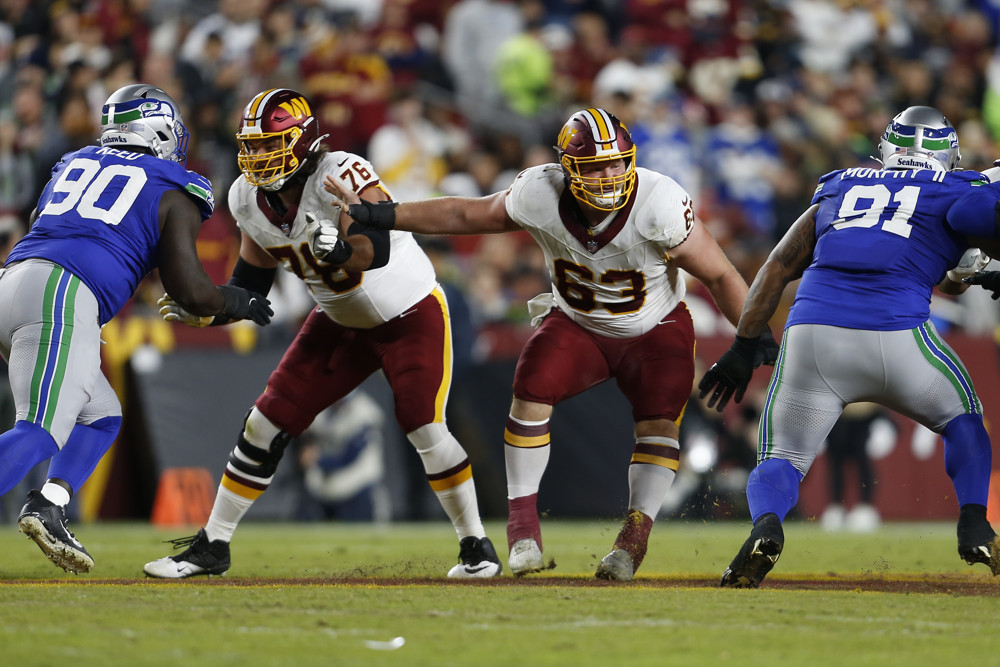
Washington released Tyler Biadasz on February 27th to recover $2.8 million in cap space. They were already in tight territory after their NFC Championship run, and shedding a veteran center they’d paid $10 million per year was a clean accounting move. They extended Nick Allegretti on March 2nd, who filled in for Biadasz for two games after injury in December, and liked what they saw enough to make a cost-saving move.
Six days later, Joe Hortiz signed him for $30 million.
The Chargers entered free agency with nearly $99 million in cap space. They weren’t signing Biadasz because the price was right. They were signing him because the price was right, the player was right, and the timing created an opportunity that disappears once traditional free agency crowds the market. Biadasz was on the street before the legal tampering window officially opened. The Chargers visited him in person on March 5th and had a deal by the morning of the 6th.
That sequence is worth understanding. But the bigger story isn’t the speed. It’s that this signing works simultaneously across all three of the budget constraints this series has been tracking: cash spending, salary cap, and compensatory picks. Moves that check all three boxes at once are rarer than people think. This one does.
Running the Deal Through All Three Budgets
If you’ve been following this series, the frame is familiar. Every move Hortiz makes gets evaluated against three simultaneous constraints. The Biadasz deal passes all three. The third one is the part most coverage will miss entirely.
Compensatory picks: pay attention here. We covered the comp pick formula in Part 3 of this series. The short version: a Compensatory Free Agent is a player whose contract expired naturally and who then signs with a new team inside the qualifying window. That player counts as a CFA gained, which can cancel out a comp pick the Chargers would otherwise receive for a departing player.
Biadasz doesn’t qualify under that definition. Washington cut him outright. His contract wasn’t allowed to expire. It was terminated. That makes him a street free agent, not a CFA gained. Under the CBA, released players simply don’t register on the cancellation chart.
This matters enormously in the context of what the Chargers are managing this window. Odafe Oweh, Khalil Mack, Zion Johnson, Benjamin St-Juste: all potentially generating comp picks if they walk. Every time the Chargers sign a qualifying free agent from outside, they risk cancelling one of those losses. Biadasz doesn’t touch any of it. The Chargers get a starting center and their comp pick math stays exactly where it was.
Hortiz has said publicly and repeatedly that he values compensatory picks. He generated 23 of them in his 11 years in Baltimore. The decision to target a cut player rather than a traditional UFA center isn’t a coincidence. It’s a pattern.
Cap: efficient by design. At $10 million AAV, Biadasz sits comfortably below the market rate for a franchise center. Tyler Linderbaum was projected in the $22-23 million range. Connor McGovern was expected to cost real money too. The Chargers could have entered the center market with a top-of-market commitment that compressed flexibility on everything else. Instead, Hortiz found a legitimate starter at the $10 million tier, leaving the checkbook open for the conversations that define this offseason: edge rusher, guard depth, and corner.
The year-one cap hit will land well below the $10 million AAV based on how the Chargers typically structure deals. That front-loaded flexibility matters when you’re still making decisions on the rest of the roster in the first 48 hours of the window.
Cash: fair and bounded. Washington signed Biadasz to a 3-year, $30 million deal in March 2024. The Chargers are paying $30 million over three years now. The nominal difference is negligible. The context is not: the NFL salary cap has risen substantially since 2024, which means $10 million per year at center buys meaningfully more today than it did two offseasons ago. Multiple analysts have already noted that Washington erred in cutting rather than trading Biadasz, given the market value available at the position. The Chargers didn’t just pay fair market. They paid close to 2024 prices in a 2026 market.
The deal structure likely mirrors something close to what Over the Cap is reporting for similar 3-year, $30 million contracts this cycle: a year-one cap hit near $6 million with years two and three landing around $12 million each, keeping annual cash outlay close to $10 million out the door. The backloading could be structured more aggressively depending on how the Chargers want to manage flexibility in 2026, or kept more balanced. Either way, the leverage dynamics of being a street free agent rather than a traditional UFA kept the price range controlled. This isn’t a desperation signing at an inflated number. It’s the opposite.
What the Numbers Actually Say
Tyler Biadasz is 28 years old. He grew up on his grandfather’s 1,000-acre dairy farm in Amherst, Wisconsin, recruited to play defensive end, converted to center, and eventually became the best center in college football. He won the 2019 Rimington Trophy (the first ever for a Badger), finished as an Outland Trophy finalist (losing to Penei Sewell), and blocked for Jonathan Taylor during the three-season run in which Taylor became the first FBS player to rush for over 6,000 career yards.
The Cowboys traded up for him in the 2020 fourth round, dealing a fifth-round pick to Philadelphia to get him. He was the designated Travis Frederick successor. He became a full-time starter in 2021, earned a Pro Bowl nod in 2022, and followed Dan Quinn from Dallas to Washington in 2024. He started 31 of 34 games for the Commanders over two seasons, including the offensive line that anchored the NFC Championship Game run.
That context matters because it tells you what kind of player the Chargers are acquiring. This isn’t a reclamation project or a bridge option. This is a center trained as a franchise player at an elite program, developed inside one of the NFL’s most refined offensive line rooms, and durable enough to log over 1,100 snaps per season every year from 2021 through 2024.
The numbers in 2025 were the best of his career.
| Player | Overall | Run Block | Pass Block | True Pass Set | Pressures | QB Hits | Sacks | PBE |
|---|---|---|---|---|---|---|---|---|
| Tyler Biadasz | 70.7 | 71.2 | 67.1 | 68.5 | 21 | 0 | 3 | 97.7 |
| Bradley Bozeman | 49.8 | 50.0 | 45.6 | 46.5 | 36 | 6 | 3 | 97.1 |
Bozeman finished the 2025 season last among qualifying centers in PFF’s overall grade. 49.8. 36 pressures allowed. Six QB hits on a team that asked him to protect Justin Herbert on nearly 700 pass plays. That 45.6 pass block grade puts him in historically poor company for a full-time starter. The comparison to Biadasz isn’t close in any column.
One number worth singling out: Biadasz allowed zero QB hits in 2025. Across the past two seasons combined, that number is still zero. Those are direct, post-release-quarterback contacts: the kind that lead to injury, disrupted timing, and a quarterback developing bad habits in the pocket. It’s also important to point out he did so last year with Marcus Mariota and Josh Johnson combining for six starts, two backup QB’s that are more apt to hang onto the football and contribute to pressures and sacks than an established starter. For Herbert, who has absorbed more in-the-pocket punishment than his physical gifts should require, this is not a minor distinction.
His grade progression tells a story of a player with a clear upward trend over the second half of his career:
| Season | Team | Overall | Run Block | Pass Block | Snaps | Games |
|---|---|---|---|---|---|---|
| 2021 | DAL | 65.4 | 68.7 | 70.1 | 1,274 | 18 |
| 2022 | DAL | 60.5 | 58.4 | 64.3 | 1,195 | 18 |
| 2023 | DAL | 69.2 | 68.3 | 64.6 | 1,123 | 17 |
| 2024 | WAS | 64.2 | 62.9 | 62.8 | 1,166 | 18 |
| 2025 | WAS | 70.7 | 71.2 | 67.1 | 954 | 16 |
The 2022 dip and the 2024 step back at Washington are worth noting. Neither was a catastrophic decline, and both were followed by rebounds. What’s more meaningful is that 2025 was a career-best in both overall and run block grade despite Washington shifting heavier toward gap concepts in the second half of the season. A player who peaks in his age-27 season while absorbing a mid-year scheme adjustment is not a player who is declining.
The McDaniel Connection
Mike McDaniel was hired as Chargers offensive coordinator on January 26th. He is a Shanahan-tree disciple. In Miami, he ran zone-heavy concepts on 54-60% of rushing snaps in every season he was there. At the Combine this year, Hortiz explicitly drew the comparison to the 2014 Baltimore Ravens, when Gary Kubiak arrived and the organization installed wide zone as its foundational run concept. “We went to the wide zone,” Hortiz said. McDaniel’s system, Hortiz noted, is now reflected in how the Chargers approach scout reports. Although fans continuously tout that McDaniel will lead the charge in finding scheme fits for this offense, it’s important to point out that Hortiz has familiarity here as well.
Biadasz spent three years at Wisconsin running an inside-zone heavy system under offensive line coach Joe Rudolph. That’s the foundation he was built on. But the more actionable data point isn’t his background. It’s his 2025 splits.
| Concept | Grade | Snaps | % of Run Snaps |
|---|---|---|---|
| Zone | 66.2 | 143 | 37.3% |
| Gap | 67.2 | 214 | 55.9% |
Zone grade: 66.2. Gap grade: 67.2. The number that matters here isn’t either grade in isolation. It’s how close together they are. A center who performs nearly identically in both concepts isn’t going to regress while absorbing a new playbook. He’s already operating without a scheme crutch. For an offensive coordinator installing an unfamiliar system, that flexibility is genuinely valuable.
There’s no direct prior coaching connection between Biadasz and the current Chargers staff worth overstating. No former coach brought him here, no relationship drove this. The fit is schematic and philosophical: a Wisconsin zone-trained center stepping into a Shanahan-tree offense, with the grades confirming he can execute in gap looks just as comfortably.
The Injury Context
Biadasz suffered knee and ankle injuries on Christmas Day 2025 in Week 17 against the Cowboys. He was placed on IR December 31st and missed the regular-season finale. The injuries did not require surgery. He missed one game.
For context: Biadasz logged over 1,100 snaps per season in every year from 2021 through 2024, including all 18 games in 2024 with Washington. Lower-extremity sprains with no surgical intervention generally resolve within 6-8 weeks. From Christmas Day to training camp is approximately five months. The math is not alarming.
What’s more telling than any timeline projection is the sequence of events: the Chargers visited Biadasz in person on March 5th and had a deal done the following morning. You don’t sign a player for $30 million the morning after a face-to-face medical evaluation if the report raises serious concerns. Hortiz and his medical staff have earned the benefit of the doubt when it comes to player evaluation decisions. This signing reflects a front office that saw what it needed to see.
It’s worth monitoring heading into camp. It’s not a reason to discount the signing.
What One Signing Actually Solves
The best signings close one conversation and open three others.
Center is off the board. Hortiz doesn’t have to bid for Linderbaum. He doesn’t have to overpay a bridge option at the position while trying to address more expensive needs. One signing removes an entire roster question from the active negotiation window and redirects attention toward the decisions that define this offseason: Odafe Oweh, Khalil Mack, Zion Johnson, and two wide-open guard spots.
That’s what the three-budget frame clarifies. This isn’t just a $30 million center signing. It’s a $30 million comp-pick-neutral, cap-efficient, cash-controlled center signing on the first morning of free agency. It gives Hortiz a clean starting position on the rest of the window.
Joe Alt and Rashawn Slater are coming back at tackle. Biadasz slides in at center on a deal that doesn’t crowd the cap, doesn’t touch the comp pick ledger, and doesn’t compromise the cash budget for what comes next. He does it without the team giving up anything: no comp pick cancelled, no pick traded, no other position robbed to pay for him.
The Chargers needed a center who could protect Justin Herbert, process McDaniel’s zone concepts, and stay healthy through a playoff run. They found one who has allowed zero QB hits over the past two seasons, grades top-11 among centers league-wide, and was trained on the exact scheme McDaniel is installing. Washington let him go to save $2.8 million. LA signed him before most teams finished their morning coffee.
The Biadasz signing is easy to like in isolation. Center upgrade, reasonable AAV, comp-pick-neutral. Straightforward. But the more interesting question is what it tells us about where Hortiz is actually headed this offseason, and that answer isn’t settled yet.
Here’s the fork in the road. If the Chargers re-sign Oweh, Mack, and Zion Johnson internally, those comp picks were never coming anyway. The ledger would have been wiped regardless of what happened at center. In that scenario, there was no real structural reason to avoid Linderbaum either: a handful of internal re-signings would have absorbed the same formula space. The Biadasz decision looks more like cost management than comp pick architecture.
The other path is the one that makes this signing feel like a genuine strategic statement. If Hortiz goes out and loads up on starter-level compensatory free agents at multiple positions, he’s not choosing Biadasz as the affordable fallback. He’s choosing him as the answer, and freeing up comp pick capital to spend elsewhere on the roster intentionally. In that version, this wasn’t a concession. It was the plan all along.
What I’m hoping we don’t see is the middle path. The one we’ve watched before: moderate spending on a volume of second-tier free agents that isn’t impactful enough to move the needle but still wipes out the comp pick return. That’s the outcome where Biadasz ends up looking like a symptom of half-measures rather than a strategy. The comp pick ledger stays intact today. The next few signings will tell us whether Hortiz intends to keep it that way, or whether this window quietly drifts into no man’s land.
That’s the move. Not just a player acquisition. A resource allocation decision that frees up the most important conversations still ahead. What path do you think Hortiz is running here, StormCloud? Is Biadasz the anchor of a deliberate comp pick strategy, or the first domino in a window that spends its way out of the third budget entirely?
Data sources: PFF (overall grades, run/pass block grades, zone/gap splits, true pass set grades, pass blocking efficiency, career grade progression, pressure and sack totals), Over the Cap (contract values, comp pick formula mechanics, cap space figures), Spotrac (Biadasz contract terms, Washington release details and cap savings). All PFF grades reflect the 2025 NFL regular season. Ranking context (11th of 40 qualifying centers; 43rd of 43) uses PFF’s minimum snap qualification thresholds. Career PBE (Pass Block Efficiency) of 98.0 reflects full six-season career, per PFF.