

How Much Can the
Chargers Actually
Spend This Offseason?
A Championship Window, Narrow but Glaring Needs, and the Cash to Attack Both
Two straight 11-win seasons. A franchise quarterback in his prime. A general manager who spent his first year here deliberately rebuilding the roster’s financial foundation. The Los Angeles Chargers enter the 2026 offseason in a position most fan bases only dream about — legitimate contenders with the resources to make a real run.
But if you’re expecting Joe Hortiz to go nuclear with the checkbook, you may need to temper expectations slightly. Hortiz has been explicit about his philosophy: he is a “cash to cap” spender, meaning he targets spending that roughly mirrors the salary cap in real dollars rather than dramatically front-loading deals to exceed it. Understanding what that looks like in practice — and where his ceiling actually sits when the window is open — is the entire point of this piece.
We analyzed ten years of NFL cash spending data across all 32 teams, pulled the Chargers’ current cap situation from Spotrac and Over the Cap, and built out a realistic projection for what LAC’s true free agency budget looks like in 2026. Here’s what we found.
What the Numbers Say: LAC, BAL, and the League Baseline
The table below shows cash spending — actual dollars paid to players, not cap accounting figures — alongside each team’s cash-to-cap ratio. These two numbers tell very different stories than the cap headlines you see everywhere else. The 2026 salary cap has been officially set at $301.2 million.
Three things stand out immediately. First, the Chargers’ 2024 number of 93.6% was entirely intentional. Hortiz came in alongside Jim Harbaugh with a roster that needed clearing, and he spent below the cap in real cash — something almost no team does by accident. That was the reset year, and it worked. They used that discipline to build a clean foundation.
Second, the Ravens in Hortiz’s tenure were consistently aggressive when the window was open, hitting 130-154% of the cap in 2021, 2022, and 2023. His “cash to cap” label doesn’t mean conservative — it means proportional. When Baltimore was in win-now mode, cash went out the door accordingly.
Third, note that both LAC and BAL pulled back in the years they were resetting or rebuilding (BAL 2024 at 100.6%, LAC 2024 at 93.6%). That pattern is deliberate. The aggression gets turned back on when the team is ready — and the Chargers, coming off back-to-back 11-win seasons, are clearly ready.
Where the Chargers Stand Heading Into Free Agency
According to Over the Cap, the Chargers currently carry $218.6 million in cap obligations for 2026. With their rollover from last season, that puts their available cap space at approximately $85.5 million — before any cap-clearing cuts. But the more important number for this analysis is their actual cash committed: just $160.8 million — 30th in the NFL per Spotrac. That gap exists because cap accounting includes prorated signing bonus money from prior years that doesn’t represent new cash out the door in 2026.
Teair Tart’s recently signed extension is a perfect illustration of how this works. His deal was widely reported as three years worth up to $37.5 million, but $7.5M of that is incentives — the base value is $30M, or $10M per year. In 2026, Tart will actually receive $10,020,000 in cash. His cap number, however, is only $6,020,000 — $4M less — because a portion of his signing bonus is prorated across the life of the deal rather than counted all at once. Multiply that kind of structure across a full roster of multi-year contracts, and you can see why the Chargers’ cash obligations ($160.8M) land so far below their cap number ($218.6M). It also illustrates how cap-savvy teams use signing bonus proration to create cap efficiency — paying players their full cash value while spreading the cap cost across multiple years. That’s a tool Hortiz will have available on every deal he signs this offseason.
Several roster cuts will further reduce the cash picture before free agency opens. Mekhi Becton’s expected release removes $10M in cash and ~$9.7M in cap. Will Dissly is another rumored cut, saving $4M in cash. Bud Dupree is on the bubble as well, clearing $3.5M in cash. Cut all three and the cash committed drops to approximately $143.3M. Bradley Bozeman’s retirement is already reflected in current figures. We’re working from that post-cut cash baseline of ~$143.3M, plus a $30M reserve for the draft class and in-season needs, for a total of ~$173.3M spoken for — leaving the remainder of the total cash budget available for free agency.
The cap picture is straightforward and genuinely elite — the Chargers are at or near the top of the league in available space. But cap figures tell only half the story. The cash budget is where Hortiz’s true philosophy gets revealed, and that’s a separate calculation entirely.
Three Scenarios for Total 2026 Cash Spending
Cash spending — real dollars paid to players in a given year — is the truer measure of a front office’s ambition. It can’t be restructured or deferred the way cap numbers can. When Hortiz says “cash to cap,” he means he won’t wildly blow past the cap number in actual payments. But as Baltimore demonstrated repeatedly, that ceiling can still be 130-154% of the cap when the moment calls for it.
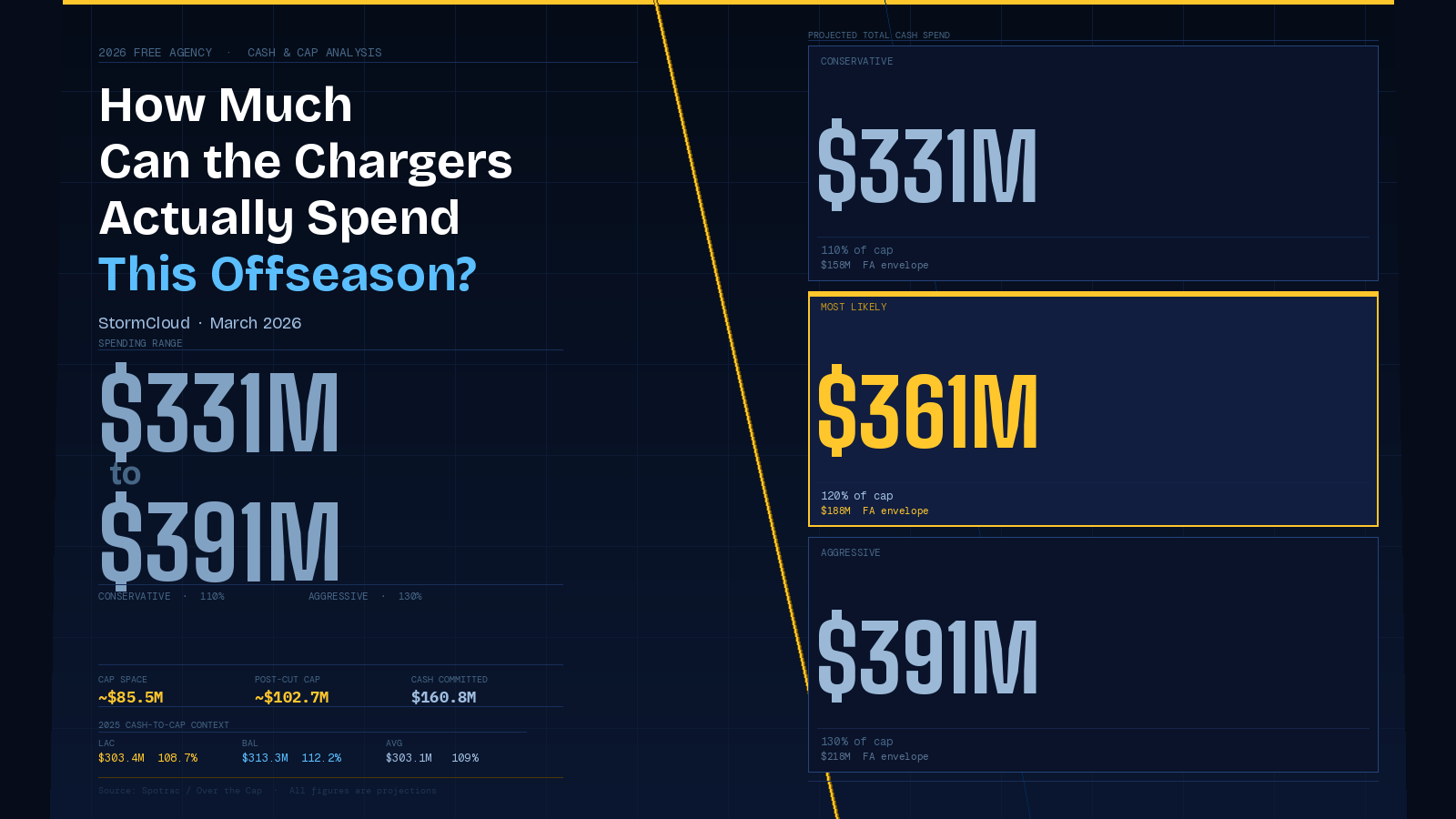
Below are three realistic scenarios for the Chargers’ total 2026 cash outlay, along with what each leaves available for free agency. The math: take the total projected cash spend, subtract the post-cut cash base of ~$143.3M already committed to signed players, and subtract the $30M draft/in-season reserve (~$173.3M total spoken for). The remainder is the cash envelope for free agency.
The math behind each scenario: take the total projected cash spend, subtract the ~$143.3M post-cut cash base, and subtract the $30M draft/in-season reserve. The remainder is the cash envelope available for free agency contracts signed this offseason.
Three Decisions That Will Define This Offseason
Here’s the thing about that $188M cash envelope: the allocation of it is genuinely complicated, and it comes down to a three-way decision that will define this entire offseason. Those decisions are interconnected, and getting all three right is what separates a good offseason from a great one.
Decision 1: What is Zion Johnson’s market, and does Hortiz meet it? Johnson hit free agency after the Chargers declined his fifth-year option, then had his best season in 2025. His market is projected at roughly $11M/year by Spotrac, but some reports out of the Combine suggest it could push toward $20M annually — which would make him one of the higher-paid guards in the league. Hortiz was characteristically measured at the podium: “We’ll stay engaged with him through the process.” The Chargers could technically sign Zion alongside Oweh, Mack, and Linderbaum, but doing so would lock up three premium interior salaries (Linderbaum, Zion, and Slater), leaving right guard still a need — and far less flexibility when Joe Alt’s extension comes due, plus deals for Quentin Johnston, Daiyan Henley, Tarheeb Still, and others rising through the roster. The real question isn’t whether they can sign him — it’s whether they should, and at what price.
Decision 2: Can the Chargers land Tyler Linderbaum? The three-time Pro Bowl center — Hortiz’s former colleague in Baltimore, where he watched Linderbaum develop since the 2022 draft — is the best offensive lineman in free agency and widely projected to command $20M+ per year on a four-year deal. The Chargers have been specifically named as a threat to sign him, and their need is obvious after a historically bad offensive line season in 2025. But Linderbaum comes with a significant catch: signing him would negate a compensatory draft pick the Chargers would otherwise receive if Zion Johnson or Odafe Oweh — both threatening 3rd-round comp pick value — depart in free agency. How that trade-off pencils out is a topic we’ll explore in depth in our upcoming piece on compensatory picks — but it’s a real factor in Hortiz’s calculus.
Decision 3: Oweh and Mack. Edge rusher Odafe Oweh is the marquee defensive free agent. His market value cratered leading up to his trade from Baltimore — he was struggling and inefficient before the move, with the trade itself the climax of that decline — but his resurgence in LA has restored his stock considerably. A reasonable landing place is around $20M per year — Josh Sweat’s 4-year/$76.4M deal ($19.1M AAV, roughly 6.3% of the cap when signed) is a useful ceiling comp given the similar profile: explosive athleticism, productive but not elite sack totals, and a pass rusher who has figured out how to win at the NFL level. Oweh’s year-one cap hit could land around $8-9M through signing bonus proration, providing genuine cap flexibility even on a top-dollar deal. Khalil Mack at 34 is a separate conversation — his 5.5 sacks in 12 games show he can still contribute, but his next deal is likely a final one-year contract in the $13-15M range. Whatever he signs for hits both cash and cap simultaneously.
Here’s where the comp pick wrinkle enters. The Ravens organization — Hortiz’s DNA — is famously comfortable letting players test the open market rather than overpaying, specifically because large departures generate compensatory draft picks. If Johnson and Oweh both command $20M+ on the open market and the Chargers let them walk, they could collect two significant comp picks and pivot away from Linderbaum entirely — redirecting those dollars to value centers like Lloyd Cushenberry or Tyler Biadasz, recently cut veterans with proven starting experience who wouldn’t cost anywhere near Linderbaum money. Signing Linderbaum, by contrast, would cancel a comp pick they’d otherwise receive for losing Zion or Oweh. The full calculus of how compensatory picks shape free agency strategy — and whether Hortiz is inclined to play that game — is a topic we’ll dig into in the next piece in this series.
In cash terms, retaining Oweh (~$25-30M year-one cash) and Mack (~$13-15M) accounts for roughly $40-45M of the FA cash envelope. Linderbaum at ~$20M/year adds another significant line. The remaining envelope — potentially $100M+ in cash depending on which internal players are retained — is still substantial for outside additions, though the cap constraint (~$85.5M available before cuts) is the real binding number on any deal structure.
Hortiz will be deliberate. Expect early-market signings on his own guys, patience on outside targets, and no panic overpays. That’s the Baltimore way, and it’s now the Chargers’ way too.
The StormCloud Projection
Total Cash Spend: ~$361M | ~120% of Cap
The Chargers will spend at approximately 120% of the salary cap in real cash — a meaningful step up from the 2024 reset (93.6%) and the 2025 return to baseline (108.7%), consistent with the Ravens’ mid-level win-now posture and comfortably within Hortiz’s stated philosophy.
The buried lede is how low their current cash commitments actually are. At $160.8M — 30th in the NFL — the Chargers are near the very bottom of the league in real dollars already spoken for. After expected cuts (~$17.5M in cash savings) and a $30M draft/in-season reserve, the free agency cash envelope in the most likely scenario lands at approximately $188 million. The cap-side constraint — approximately $85.5M available before cuts — is the actual binding number on deal structures. You can have all the cash in the world; you still need cap room to absorb the hit.
The real story of this offseason isn’t one big number — it’s three interlocking questions. Can Zion Johnson and Odafe Oweh command $20M+ APY on the open market, and if they do, should the Chargers match? If Oweh stays but Zion walks, does it still make sense to sign Linderbaum and give up the 3rd-round comp pick that Zion’s departure would generate? The Chargers could keep all three — Oweh, Zion, Mack — and add Linderbaum on top, but that’s a full core reset that mortgages future flexibility against players like Quentin Johnston, Daiyan Henley, Tarheeb Still, and Ladd McConkey when their extensions come due. Zion’s market is the most unpredictable variable in the whole equation — underpay him and he walks; overpay him and you’ve burned dollars that could have gone elsewhere. How the comp pick system shapes all of that math is the subject of the next piece in this series.
Data sources: Spotrac (cash table, cap space projections, contract details, offseason financials series), Over the Cap (live cap obligations), NFL Cash Spending Data 2016–2025 (all 32 teams). All figures are projections and will shift as contracts are signed, released, or restructured. The 2026 NFL salary cap is officially set at $301.2M.
































Great stuff Kyle – thank you.
Inn reading the article, I think it became clear to me that Zion is gone, Oweh is likely back and Linderbaum is a low-likelyhood signing.
Center is much more important than either guard position. While Zion was decent last year (on an absolute dumpster fire OL), he was the 53rd (out of 81) rated guard according to PFF. Should the Chargers pay $80-$100M for a guard that’s decent, but below-average? You could argue that the scheme and who he was playing next to contributed to poor play, and you may have a point. However, betting big $ on that assumption vs. rewarding on-field play seems pretty damn speculative. I think the Chargers are better served spending on center.
Linderbaum is a possibility, depending on how Joe feels about Tyler and how Tyler feels about the Chargers. Tyler was PFFs 5th (out of 40) ranked center (Bozeman was 40th!). Linderbaum is clearly a huge upgrade at the position, but how much should the Chargers allocate for center and how important is IOL to McDaniels scheme vs. the importance of Oweh to the defense? I think if given the choice, Oweh is the priority.
Tyler Biadasz was the 11th ranked center, but is coming off a serious injury. Lloyd Cushenberry was the 36th ranked center in 2025. Both have risks. Are either good enough to function at a reasonable level in a McDaniels offense?
My predictions:
Not sure what happened to the formatting above (or why it turned the type white).
Here’s the first bit of the comment:
Great stuff Kyle – thank you.
Inn reading the article, I think it became clear to me that Zion is gone, Oweh is likely back and Linderbaum is a low-likelyhood signing.
Center is much more important than either guard position. While Zion was decent last year (on an absolute dumpster fire OL), he was the 53rd (out of 81) rated guard according to PFF. Should the Chargers pay $80-$100M for a guard that’s decent, but below-average? You could argue that the scheme and who he was playing next to contributed to poor play, and you may have a point. However, betting big $ on that assumption vs. rewarding on-field play seems pretty damn speculative. I think the Chargers are better served spending on center.
Linderbaum is a possibility, depending on how Joe feels about Tyler and how Tyler feels about the Chargers. Tyler was PFFs 5th (out of 40) ranked center (Bozeman was 40th!). Linderbaum is clearly a huge upgrade at the position, but how much should the Chargers allocate for center and how important is IOL to McDaniels scheme vs. the importance of Oweh to the defense? I think if given the choice, Oweh is the priority.
Tyler Biadasz was the 11th ranked center, but is coming off a serious injury. Lloyd Cushenberry was the 36th ranked center in 2025. Both have risks. Are either good enough to function at a reasonable level in a McDaniels offense?
My predictions: