

The Compensatory
Pick Rudder
The Third Budget Nobody Talks About
We’ve covered two of the three budgets that actually govern an NFL offseason. Cap space gets the headlines. Cash spending sets the real ceiling. But there’s a third lever that never shows up in press conferences, barely registers in national coverage, and quietly shapes more roster decisions than most people realize.
Compensatory picks.
Every time one of your UFAs walks and signs elsewhere, the comp formula is watching. Every time you go sign somebody else’s free agent, it’s watching that too. At the end of the season, the NFL tallies the ledger: outgoing versus incoming. Teams that came out net negative get extra draft picks. The picks drop into the back half of rounds three through seven, and since 2017, they’re tradeable. That’s what makes them more than a consolation prize. They’re liquid assets. Joe Hortiz knows exactly how to generate them.
In the eleven years before Hortiz made the move from Baltimore to Los Angeles, the Ravens collected 23 compensatory picks: four 3rds, nine 4ths, three 5ths, three 6ths, four 7ths. More than two extra picks per draft, every single year. In only one of those eleven seasons did Baltimore sign more compensatory free agents than they let walk.
That’s not a coincidence. That’s a system. And Hortiz packed it with him when he came west.
Following the releases of Mekhi Becton and Will Dissly, the Chargers are heading into free agency with nearly $100 million in cap space, a cash budget that could push well past $180 million, and 21 UFAs waiting on their next contract. What Hortiz does over the next two weeks fills holes for 2026, yes. But it also sets the comp pick return in the 2027 NFL Draft. That’s the third budget. This is how it works.
A CBA Crash Course, Through the Chargers Lens
The compensatory pick system is buried in Appendix V of the CBA, and the full rulebook is dense enough to make your eyes glaze over. But the core logic isn’t complicated. Once you see it, you can’t unsee it.
Who qualifies. A Compensatory Free Agent is a player whose contract expired naturally (not a cut, not a trade, not a release) who signs with a new team between the start of free agency in March and the Monday after the draft in April. Their new deal has to rank in the top 35% of all NFL contracts to count. Anything below that line is invisible to the formula.
For the Chargers, that means Najee Harris, coming off a torn Achilles and likely signing at or near the minimum, doesn’t register. Same goes for most of the depth pieces at the bottom of the board: Andre James, Bobby Hart, Hassan Haskins, Trey Lance. Their next deals won’t clear the threshold. The formula only cares about real money. And Mekhi Becton and Will Dissly don’t enter the equation at all. They were released, not allowed to hit free agency, which makes them completely invisible to the formula. That distinction matters when you’re building the ledger.
How value is determined. Each qualifying player gets a Final Numerical Value built on three inputs: average annual value of their new deal (by far the most important factor), snap percentage during the season (minimum 25% of offensive or defensive plays), and any postseason honors like All-Pro nods. That value gets ranked against every other qualifying player in the league (roughly 1,960 to 1,970 players total), and the percentile determines which round the comp pick falls into.
The round brackets. Based on 2025 comp pick results (our most current data point), here’s roughly where the APY thresholds fall:
| Round | Approx. APY Range |
|---|---|
| 3rd | ~$20M+ |
| 4th | ~$15M – $20M |
| 5th | ~$10M – $15M |
| 6th | ~$6M – $10M |
| 7th | ~$3.2M – $6M |
| Non-qualifying | Below ~$3.2M |
There’s one caveat that hits directly for the Chargers this offseason: any non-quarterback with 10 or more accrued seasons is capped at a 5th-round comp pick, regardless of what they sign for. One Charger in this free agent class has that ceiling. His name is Khalil Mack.
Where It’s Easy to Fumble the Formula
Here’s the piece of the formula that most people miss. Get it wrong and you’ll misread free agency decisions all offseason long.
When the NFL scores the comp ledger, it’s not a simple headcount of departures versus arrivals. It runs a one-for-one cancellation process, and the order of operations matters enormously. The CBA spells it out in Appendix V, §3(a):
First, a CFA gained cancels the highest-value available CFA lost in the same round bracket.
Second, if there’s no same-round match, it cancels the highest available CFA lost in a lower bracket (a later round).
Third, and this is the one most people get wrong: a CFA gained will cancel a CFA lost with a higher draft value only if there are no other losses available at the same round or lower.
That third rule is what makes the whole system tick. A single 7th-round signing can cancel a 4th-round loss, but only if that 4th-round loss is the only thing left on the board. If 7th-round losses are sitting there too, the incoming signing hits those first, and your 4th-round compensation walks away untouched.
This is why depth on the outgoing ledger matters so much. The bubble guys (Pipkins, Salyer, Allen, Penning, Hand) aren’t just potential 7th-rounders. They’re a firewall. Every low-level CFA you bring in hits those guys first, before it can climb up and eat your premium losses. Stack enough qualifying departures at the bottom of the ledger and the big picks at the top are much safer.
Some moves don’t touch the formula at all. Released players and traded players don’t count as CFAs gained. If Hortiz fills a hole by signing someone who was cut by his prior team, that addition never shows up on the cancellation chart. Re-signing your own guys doesn’t count either. When Hortiz extended Teair Tart to a three-year deal in January, the ledger didn’t move. Tart stayed. The chart stayed clean.
But there’s a flip side. A player you keep is a player who can’t earn you a comp pick. Retention doesn’t move the chart. No loss, no gain. But the opportunity cost is real. That tension is where the offseason juggling act actually starts.
Projecting the 2027 Comp Pick Losses
Let’s build the Chargers’ comp ledger. Every signing, every departure, every quiet non-move between now and late April feeds into the compensatory picks the Chargers will be awarded in the 2027 draft.
Using projected market values and the 2025 bracket thresholds as our guide, here are the Chargers UFAs most likely to qualify as compensatory free agents if they walk:
| Player | Pos | Est. APY | Proj. Rd | Notes |
|---|---|---|---|---|
| Odafe Oweh | EDGE | ~$20M | High 4th / low 3rd | $21M+ needed to cross into 3rd territory |
| Khalil Mack | EDGE | ~$15M | 5th (capped) | 10+ accrued seasons — CBA caps at 5th |
| Zion Johnson | G | ~$14M | 5th | Biggest unknown — could land $10–20M |
| Benjamin St-Juste | CB | ~$7M | 6th | Corner market could push higher |
| Trey Pipkins III | RT | ~$6M | 7th | Starter-level tackle, modest market |
| Bubble | ||||
| Jamaree Salyer | G | ~$4M | 7th (bubble) | Right at the qualifying threshold |
| Keenan Allen | WR | ~$4M | 7th (bubble) | Expected to re-sign |
| Trevor Penning | OT | ~$3.5M | Bubble | May fall below ~$3.2M qualifying line |
| Da’Shawn Hand | DL | ~$3.2M | Bubble | Right at the floor |
A few of these projections lean optimistic. Intentionally so, to reflect what the player and Hortiz might realistically hope the market bears. The math shifts if a player misses a bracket. If Zion Johnson settles in the $9–10M range instead of $14M, his comp value drops from a 5th to a 6th. Suddenly there’s a lot more incentive for Hortiz to bring him back on a bridge deal rather than let him walk for diminished return.
Four players on the bubble. Five likely in qualifying range. The real question: can Hortiz nail his priority re-signings, add a free agent target or two, and still bank at least two comp picks for the 2027 war chest? Two-plus per year was the Baltimore baseline. That’s a fair benchmark for what Hortiz would call a successful third-budget offseason.
What the Cancellation Chart Could Look Like
Like the cash budget breakdown in Part 2, this isn’t a single prediction. It’s a range. The comp pick result depends entirely on which dominoes fall and in what order. Here are three realistic paths, each with a cancellation chart showing how the ledger shakes out.
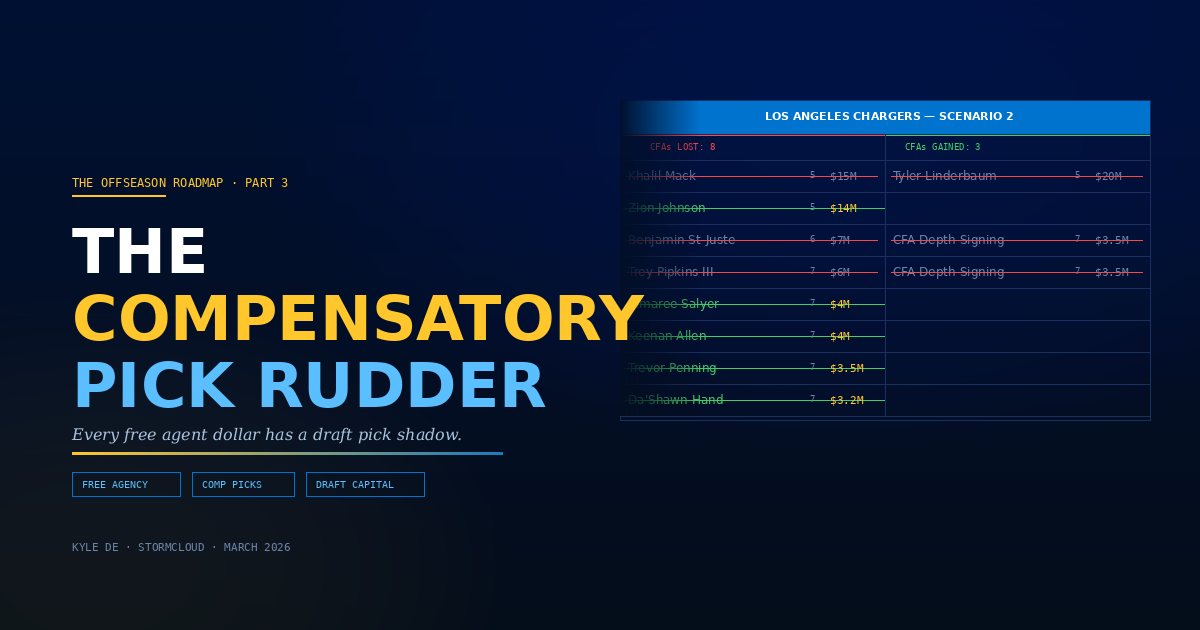
The Chargers see enough young talent in FA and internally to finally re-establish the core they broke down in 2024. Oweh is signed long-term, and Mack also stays in a “win now” year. Hortiz goes out and signs Tyler Linderbaum (~$20M APY per PFF) and Isaac Seumalo (~$8M APY per PFF). The remaining holes get filled through re-signings, cut candidates, and the draft.
It’s important to note: The CFA depth signings in this scenario could be entirely dependent on the “CFA Lost” side of the ledger. If Penning or Salyer don’t qualify for a pick, they may decide to pass on one or two depth CFA pieces, or target lower salaried CFA’s. That’s where the nuance coming into play.What happens: Linderbaum cancels Zion’s 5th. Seumalo cancels St-Juste’s 6th. Three depth-level CFA signings cancel Pipkins, Salyer, and Allen. Penning and Hand are what’s left, and you need both to clear the ~$3.2M qualifying threshold to count. If three or more of the bubble guys had qualified instead of two, Hortiz could have added another CFA at the 7th-round level without penalty; the buffer losses would absorb it.
The comp pick return is modest. But that’s kind of the point. The heavy cash and cap commitments baked into this scenario will curb free agent spending for a couple of years, which means the harvest comes later. The 2028 and 2029 ledgers look very different as Hortiz draft classes start hitting free agency, and the roster is re-established with veteran players on second and third contracts.
The Zion wrinkle: This is actually where it gets interesting. Since Linderbaum is already cancelling Zion’s comp pick anyway, and the only remaining opportunity cost is a 7th-round pick or two, Hortiz has very little reason not to bring Zion back in this scenario, especially if the early market doesn’t come in strong for him. A short-term, team-friendly deal works for both sides here. Zion gets to show-out alongside Slater, Alt, and Linderbaum (a line that – if healthy – might be the best in football) and then hits free agency again at 28 with real leverage. For Hortiz, it’s a low-risk bridge which real potential to pay off in performance and in later comp return.
Hard calls get made. The Oweh trade was a classic Hortiz move: a mid-season “kick the tires” acquisition on a high-ceiling player in a contract year, the same logic that brought Roquan Smith to Baltimore and Elijah Molden to the Bolts (though that one came just before the season). Oweh had been struggling in Baltimore. The question now is whether he turned it around convincingly enough to price himself out of a reunion. In this scenario, the Chargers retain Oweh. Hortiz and Harbaugh decide he’s the long-term partner for Tuli Tuipulotu. But Mack goes to the market at ~$15M APY, and Zion follows. His number comes in high enough that letting him walk makes more sense. The Chargers still target Tyler Linderbaum, whose incoming pick value cancels Mack’s 5th-round departure.
What happens: Oweh re-signs and never touches the ledger. Linderbaum’s incoming 3rd cancels Mack’s outgoing 5th. Highest round acquisition cancels the highest round departure, which hurts less than cancelling a third. Two depth-level CFA signings eat St-Juste and Pipkins. Zion’s 5th survives clean. Several 7th-round bubble players go uncancelled.
This is the closest thing to the Baltimore baseline. And we get to keep the franchise edge rusher.
The Chargers let Oweh walk. He cashes out at $20M+ APY somewhere else. Mack comes back on a value deal. Everyone else hits the market. Hortiz offers Isaac Seumalo a 2-year, $14M contract? Below current market projections, but that’s the point: he’s comfortable cancelling St-Juste’s pick, not Zion’s. For center, Hortiz targets cut candidates Tyler Biadasz and Lloyd Cushenberry while keeping his focus on draft capital development. If Seumalo doesn’t bite at that number, it’s other cut candidates, 7th-round-bucket veteran guards, and probably a Day 1 starting guard somewhere in the first two days of the draft.
What happens: Oweh’s 4th survives clean. Zion’s 5th survives clean. Seumalo (if he signs) cancels St-Juste. Three depth-level CFA signings take out Pipkins, Salyer, and Allen. Mack re-signs and never touches the ledger. Penning and Hand remain as potential 7th-rounders if they qualify.
Cash and cap land in a similar place to last year, with resources preserved for core retention and early extensions heading into 2026 and 2027. Maximum draft capital return. Potentially the richest comp pick haul the Chargers have seen in years.
The trade-off: You’re betting on cut candidates and the draft at center. No Linderbaum. No blue-chip interior line. But you build a war chest that could turn into foundational pieces in 2027 and beyond. Depending on where you think this roster sits right now, that might be exactly the right call.
Reading the Wind
Comp picks won’t set the course — but they’ll tell you which way the wind is blowing.
Hortiz isn’t going to pass on the right roster move to protect a late-round pick. If Tyler Linderbaum genuinely transforms this offensive line, he’s signing Tyler Linderbaum. If Oweh is the edge rusher to build around, he’s paying Oweh. But the comp pick formula absolutely shapes how he constructs everything else around those anchor decisions. The early free agency moves will tell us which scenario the front office is actually running.
2025 has something to teach here. In his first offseason with that enormous cap space, Hortiz probably made a few calls he’d recalibrate with the benefit of hindsight: signing enough incoming CFAs to cancel his losses without getting the roster impact to justify it. That’s the trap. The worst outcome isn’t going big, and it isn’t going lean. It’s landing in no man’s land.
The Baltimore playbook is clear: be intentional. Let your guys test the market. Keep the door open to bring them back. Fill holes through released players and trade acquisitions that don’t touch the formula. And when you’re going to have a big CFA spending year, commit to it fully: go big, absorb the cancellations, and set the next two years up for a real harvest.
The individual decisions on Oweh, Zion, Linderbaum, and the rest of the roster come next, along with the cap gymnastics required to execute any of these paths. That’s Part 4. We’re almost there.
Data sources: CBA Appendix V (compensatory draft system), Over the Cap (cancellation charts, formula methodology, 2026 comp pick projections), Spotrac (contract valuations, free agent market data), PFF (Linderbaum and Seumalo market projections). Comp pick round brackets are approximations based on 2025 actuals and may shift with the rising salary cap. All projections assume players sign before the Monday-after-draft deadline and play sufficient snaps to qualify.































Stumbled onto this blog from a link in another Chargers discord group. Just wanted to share my appreciation, as this is some of the best Chargers content I’ve seen!