
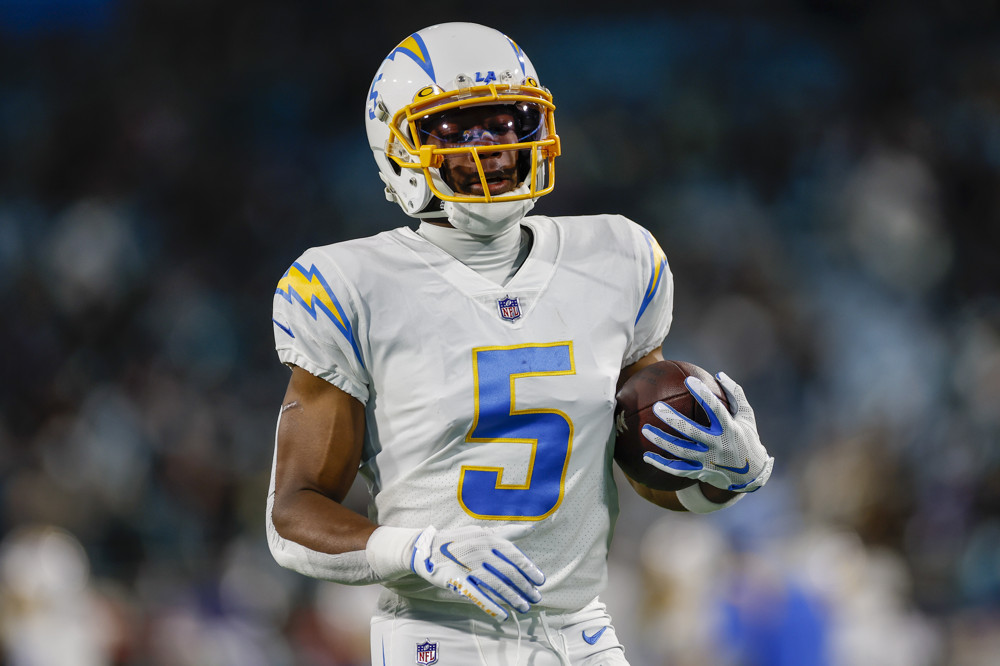

Joshua Palmer may be the greatest benefactor of the roster and staff overhaul the Chargers experienced in the 2024 offseason. After three years of playing in the recently departed Keenan Allen and Mike Wiliams’ shadows, Palmer has suddenly found himself at the top of the depth chart with no threats to his starting position, and the only receiver with whom Justin Herbert has had time to build any chemistry with.
Although the Jim Harbaugh and Greg Roman redesign of the receiver room inspires excitement over the array of different skill sets and abilities, the lack of a true “alpha” WR1 has caused this group to be widely overlooked and often seen as one of the biggest weaknesses on this roster. Although there’s no replacing Keenan Allen, Palmer entered the league drawing some comparisons to the Chargers’ star. His pre-draft offseason was impressive, and scouting profile polarizing, as he flashed dominance but had a consistently underwhelming college career. Here is what PFF had to say about him when they tabbed him as their 10th-highest rated receiver prospect in 2021:
Palmer never caught more than 34 balls or recorded more than 484 yards in a single season at Tennessee, so it’s safe to say that he isn’t a household name. But given the role he played and the quality of quarterback play at Tennessee, it’s tough to blame him. The Volunteers deployed Palmer as a deep threat almost exclusively — his 16.6-yard average depth of target was one of the highest in the country — but they just didn’t have a quarterback who could maximize that ability.
After Palmer put on a show at the Senior Bowl one-on-ones, it’s easy to see some parallels to Terry McLaurin at Ohio State. While Palmer isn’t that level of athlete, he could easily be more productive in the NFL than he was in college.
He went on to achieve a 81% win rate at the Senior Bowl, besting all other receivers in this category, and his performances against some of the top cornerbacks in the class were often referenced by scouts, such as this touchdown reception against Patrick Surtain II.
The potential is certainly there for Palmer to seize this opportunity and make a case for himself as a true WR1, just in time for his extension. But how much exactly could be at stake for Palmer in these negotiations?
If Palmer sat at the negotiating table today, he would have 143 catches, 1,705 yards, and nine touchdowns to his name, averaging 1.36 yards per route run. The closest production comparable would likely be Darius Slayton’s 122-1,832-8 three-year line (averaging 1.39 yards per route run) headed into his 2024 signing. Curtis Samuel matched Palmer’s 1.36 yards per route run in the three years leading up to his most recent deal, with a less impressive aggregate 132-1,295-8 line. These two comparables command APY’s equating to 2.43% and 3.13% of their signing year’s cap share.
Palmer has a better catch percentage than Slayton, but Samuel benefits from 4.31 speed, which teams historically assign a premium. Assuming Palmer’s cap share is somewhere between these two – approximately 2.77% – that would put his APY at $7.08 million. Slayton and Samuel earned two to three year deals; with Palmer being younger than either of these two, he’ll look for a two year deal to quickly get back to the negotiating table.
Two years, $14-15 million for Josh Palmer’s current body of work as a fringe starting receiver would earn the 40th-45th highest APY in the league. What sort of projection might Palmer hope to achieve if he breaks camp as the undisputed WR1 for Justin Herbert, and how would that affect his negotiations?
Below is a chart tracking the efficiency metrics for Palmer, Mike Williams, and Keenan Allen in the three years they played together.

Palmer’s target rate of 15.98% will undoubtedly rise now that Herbert doesn’t have his safety blanket Keenan Allen (or Austin Ekeler) on the roster. Mike Williams wasn’t known for his route running, but he still commanded a WR1A/B-type target rate as a contested catch specialist and receiver who earned Justin Herbert’s trust.
Even with a bigger emphasis on the running game than in year’s past, an increase in target rate and routes run forecast a breakout campaign for Joshua Palmer. Tyler Lockett ran the 32nd most routes amongst wide receivers in 2023, totaling 555 routes. This should be a conservative projection for Palmer in 2024, as Marquise Brown ran 625 routes in sixteen games as Greg Roman’s WR1 in 2021. However, even with this conservative estimate, Palmer’s career catch rate and yards per catch calculated off this target projection would vault him into the first 1000-yard season of his career.

Palmer’s rolling three-year aggregate stats would immediately compare closely with Niko Collins’ three years leading to his $24.25 million APY extension with the Texans. Collins is an intriguing comp because of his quiet first two seasons, until a change in coaching and quarterback allowed the receiver to flourish. His situation improved and he capitalized, which is what fans should expect from Joshua Palmer.

The key difference is Collins’ greater efficiency; his counting stats were all lower than Palmer’s in his first two years, giving Palmer the edge in receptions and yards, but Nico had a healthy lead in yards per route run. However, if we look at the two years before Collins signed his deal and compare against Palmer’s most recent two years, that edge in efficiency comes down considerably.

Collins’ efficiency jumped thanks to his 2023 improvement to 3.1 yards per route, which was second to only Tyreek Hill’s 3.82. For reference, Keenan Allen had 2.36 yards per route run in 2023, which was good enough for 11th amongst wide receivers. Even if Palmer were to match Keenan Allen’s target rate of 24.76% from ’21-’23, his yards per route run would only increase to 2.07 for this season unless he’s also able to increase his yards per reception. Collins increased his average yards per reception by more than three yards in his contract year. While projecting a jump to second in the league for any statistical category would be reckless, this is an area Palmer will to need to show reasonable improvement in if he wants to point to Collins’ deal as his true comparable for negotiations.
Assuming Palmer follows his currently trendlines and his catch rate and yards per reception remain static, the two additional receivers that could influence negotiations are Jerry Jeudy and Diontae Johnson. Jeudy has elite speed but a reputation for dropped passes and underachieving thus far in the league, and Johnson is a great comparable for a receiver with solid counting stats who was held back in negotiations because of his suboptimal yards per route run.

This is the effective salary band that Palmer should expect if he can keep himself healthy and produce to the efficiency he has in the past. The more he is able to improve those efficiency stats the way Nico did with his new coach and quarterback, the closer to matching or beating Nico’s $24.25 million APY he’ll be. Failing to seize this opportunity, or getting injured and missing considerable time this season, and Palmer’s value plummets right back to the $7-8 million APY projection range his career currently justifies.
What do you think, StormCloud? Do you believe Joshua Palmer will be able to capitalize on this opportunity?

































Davis showcased strong punt return skills when he chose to return punts, which was not often (1.4 times per game).
His kickoff return performance under the old rules was below average.
Davis also showcased a very limited WR skillset — he caught 15 passes for 66 yards, 0 TDs, and 0 first downs. I get that Johnston had high expectations and Davis did not as a WR, but it still seems very odd to me that in the same post someone would criticize Johnston’s performance as a WR while suggesting that Davis can make a positive impact as a WR given what we have seen from each of them.
Davis showcased that he can get loose on a jet sweep… he had a 51 yard run. His other 13 rushing attempts netted 50 yards (3.8 ypc).
But… I guess I’ll stop trying to counter the Davis narrative. It’s not seeming to make much of an impression. We’ll see how it plays out. As I have said, although I would advocate for trading him, I think he will most likely make the final roster.
This only works if the defense doesn’t key on the jet sweep because Davis is on the field. This means he has to actually play meaningful snaps as a WR. That means (a) running a good number of routes — instead of players like Palmer, Johnston, McConkey, Chark, Rice, and Johnson running those routes — and (b) actually having to run block, which seems like it could never be a strength for Davis simply due to his size.
Meanwhile, the Chargers now have another player who is good at jet sweeps who will be on the field a lot — McConkey.
Let’s just suppose that Davis is an actual kickoff return threat, even though he never has been at college or NFL level. Then opposing teams will just take the touchback. I previously posted a link to an article predicting a high rate of touchbacks due to the new rules and explaining why.
He returned 1.4 punts per game. He called for the fair catch on the rest. As I already posted, the Chargers had 5.4 punt return yards more than the average team. 5.4 yards per game is not huge, and that’s why it can be overlooked.
Yes, Davis took it to the house one time. He also muffed two punts and fumbled once (recovered by the opposing team) on punt returns. His overall impact on the 2023 season was negligible.
I respect your opinion on this. I have a feeling Davis will make the team, I just don’t think he is worth a roster spot. IMO the team should try to trade him in the preseason for the best draft pick they can get, leveraging all of the logic that you laid out.
These are good pts but it might not be enough to overlook what Davis is capable of and his potential at wide receiver in the new offense. So far he’s been lined up inside and outside during OTA and Training Camp, and more time he was open and blown by the coverage. I think this offense will have roles for him even in the running game with the opportunity to run more jet sweep when the opposing defense is keying on stopping the physical inside run.
I think people overreact to the new change at kickoff to favor RBs because of the new line blocking. With Davis quickness and speed and with good line blocking, if he gets thru the only line of defense with no secondary line of defense, he can easily take it to the house or some big returns. Plus, Davis is more of a scatback than your typical punt/kick returner.
Davis’ 16 yards/return at 7.6 yards better than average is HUGE. I don’t know how it can be overlooked. Your offense gets to start 16 yards from the point of kick return is massive, and the threat of Davis who can take it to the house anytime he touches the football. Jim Harbaugh prioritizes having a strong, dynamic special team.
Good stuff on Palmer, Kyle. It’s been awesome to have found you guys. You and Ryan did what you said you would. This is awesome!
Thank you brother! I’ve been hoping you’d find us – I didn’t know how to reach you to let you know we go the site off the ground. So glad we’re able to reconnect!!!
There has been nothing that I have seen to this point that makes me feel palmer is a “special” player. He has had opportunities with a top QB in a more wide open offense and has been OK. Now he is switching to a more conservative offense with a staff that holds no tie to him. Throw in the recent injury history and the odds seem more stacked against him. Considering the fact that many people believe this offensive system is not tailored to support a big time WR in the passing game anyway, why would Palmer with his “good” to “average” skill set finally have a breakout season? Now, Roman could be constructing a more open passing offense than he has in the past based off the QB talent, but barring that I think 700-800 yards is probably reasonable. Not exactly worth top dollar on the market. All things being equal, I think this regime would love to use the Chiefs model from last year. Strong defense that utilizes a run heavy approach and uses a good TE and slot options in the play action game, with the occasional shot over the top. I do not think Palmer’s skill set necessarily fits any of that. I think he projects best as a second or third option possession receiver opposite a top 1A WR in places like Dallas, Vegas, Cincy, New Orleans, and Pittsburgh. If somebody wants to pay him top dollar for that role or even a bigger one, then it is comp pick time.
Correct. I posted a lot of other metrics about him previously that IMO demonstrated that he has performed as a low end WR2 / high end WR3 caliber player in his career to date. That’s fine for his draft position, but he has never shown an ability to be a legit WR1.
I think we can assume some continued improvement, and hopefully better health. I think we can also assume increased opportunity, though I will be very surprised if he gets 125 targets as Kyle predicted here. If I had to identify a player who will lead the Chargers in targets in 2024 right now, I would choose McConkey.
It is important to note that there will likely be fewer passing attempts in this offense. For purposes of this projection, I will project 34 per game, which would be a career low for Herbert. That is 578 pass attempts. Ignoring injuries, I would estimate something like this breakdown:
WRs – 340 (~59%)
Palmer – 95
McConkey – 100
Johnston – 55 (ceiling is obviously higher here if he actually plays closer to his talent level / draft position this season)
Chark – 40
Rice – 30
Johnson – 15
Davis – 0 (projecting him to miss final roster)
Other – 5
TEs – 113 (~19.5%)
Hurst – 63
Dissly – 30
Parham – 15 (assuming he makes the final roster)
Other – 5
RBs – 110 (~19%)
Edwards – 15
Dobbins – 55
Vidal – 40
Other – 0
Other – 15 spikes/throwaways (~2.6%)
Obviously, this is just one of thousands of variations on this. The point of it isn’t to be accurate but rather to illustrate how much competition there is for targets. If Palmer is to get 125, where are the extra 30 coming from…? Other players or more pass attempts?
@tau837 Tau, your projection of 34 per game passing attempts is only 3.2 than last year’s 37.2 per game, which was top 5 in the league. A 34/game would most likely put them in the lower teens. Not bottom 10 at 30.6 passing attempts/game, or like Baltimore and Tennessee at 29.1/game (lowest) last year. Herbert will be happy with a 34 attempts/game as it isn’t a significant reduction on his passing attempts. This projection to me still favors passing over running the football, if that is what you meant.
Derius Davis the All-Pro Punt Returner 2023 not to have a role in this team after missing the 53-man roster cut would be shocking to me with how ST is always very important to a Jim Harbaugh team.
34 passing attempts per game would be his career low, and by a large margin compared to his first 3 seasons:
2020 – 39.7
2021 – 39.5
2022 – 41.2 (including postseason)
2023 – 36.6 (excluding his final partial game)
It would have ranked #14 among QBs last season and #17 among teams, if Herbert were to make every Chargers pass attempt.
Dropping by just 2.6 attempts per game may not seem like much, but it’s 44 fewer targets on the season. That was really the point of that part of my post, to show how challenging it could be for Palmer to get 125 targets.
Davis struggled to be anything other than a gadget player on offense last year. The change in the kickoff rules favors RBs as kick returners. This means that Davis will likely play 3-5 special teams snaps per game. While there’s no doubt that he’s a very good punt returner, how much better is he than the 2nd best returner on the Chargers? Is that difference enough to allocate a roster spot and (more importantly) a game-day activation for a player that can only return punts? Tau put out some very good metrics to back up this decision (which I am too lazy to look up). I did a quick google search:
The NFL averages 4 punts per team per game
The average punt return is 8.4 yards
Davis averaged 16 yards per return in 2023
The variance is 7.6 yards * 4 returns = 30.4 yards per game
I actually think this data over-estimates Davis’ impact as not every punt is returned, but let’s assume it’s right (until Tau corrects me): If Davis can get you 30.4 more yards per game, would that be more valuable to the team than keeping Cornelius Johnson who can play on all special teams and may be the best blocking WR on the team (and has the potential to develop into an NFL receiver)? It will be an interesting decision for the Chargers.
Would I be shocked if the Chargers kept Davis? No. However, keeping a receiver that can’t play receiver does not seem like a very Harbaugh thing to do.
Per PFF, 40 players had at least 10 punt returns last season. Among them:
Davis’s PR grade was #5
Davis was #2 in PR yards (385) and yards per PR (16.0)
However, he was also #2 in fair catches (29); he only returned 24 of 53 punts he fielded. So he returned an average of 1.4 punts per game. That is why the average team had 292.4 punt return yards on the season and the Chargers had 385, just 5.4 yards per game above league average.
He was a below average kick returner last season and in his college career, so even before the kickoff rules changed, he wasn’t adding value there. He doesn’t play on coverage units and played very little on offense… and now that the Chargers have added more speed in the WR group (McConkey, Chark, Johnson), there is even less reason to believe he will get meaningful snaps on offense.
IMO that just isn’t valuable enough for a roster spot.
All that said, Ficken will presumably have plenty of influence on this. If he really wants him, he’ll probably make it.
If we’re being honest, I think Quentin Johnston has more to lose with the WR additions of Cornelius Johnson, DJ Chark, and even Ladd. We can lament that Derius didn’t separate himself as a WR last season, but neither did Johnston, and Derius at least showcased gadget ability and plus-return skills. He carved out a role whereas Johnston did nothing but lower his stock, and Davis would undoubtedly be snatched on the waiver wire and not make it to the PS if he were waived. Even though poaching is pretty rare – this is the exception to the rule, as a K/PR can step into almost any ST room and make an impact, like Andre Roberts did for us in 2021. I don’t really see a scenario where a cost-controlled WR/KR with an elite trait (speed/quickness), coming off an All-Pro ST season, slips past all other 31 teams.
If I had to guess, Harbaugh will comfortably stash Rice or C Johnson on the PS. I strongly believe they would go unclaimed… specifically Johnson (Rice is a gamble with the name and all).
A great comp for these guys, especially Cornelius Johnson, is Jauan Jennings. Jennings was drafted by the 49ers in the 7th round of the 2020 draft, was waived at the end of TC, and immediately signed to the 49ers practice squad. He was injured most of the 2020 season, and signed a reserve/futures contact for 2021. He broke camp in 2021 as the WR3.
Over the next two years, he carved out a role for himself with his high motor, and eventual reputation as one of the best run-blocking WR’s in the league.
The Niners used the 2nd round RFA Tender on him this offseason as he was headed into his fourth season, and ultimately agreed to terms on a two-year extension worth over $15 million, with having only caught 78 passes for 963 yards and 7 TDs in three seasons. He doesn’t have the stats, but he’s physical and has an amazing motor.
Johnson can be a plus-run blocker, but also benefit from time on the PS. If they could trade Davis and get a draft pick for him, fantastic. But as I think Johnston was misused last year, and is probably at his floor-value level right now, I think the same of Davis. Roman loves field stretchers, and he’s not afraid to get horizontal with speed threats, which plays heavily into Derius’ strengths. I expect him to have a nice season as a returner (and I’m actually higher on his abilities translating in the new KR game than previously), while showing improvements on offense.
And despite starting on the PS, I think whichever of Rice or Johnson gets waived will still end up playing 4-6 games this season and making an impact as a higher-floor depth piece than we are accustomed to.
Summary: It’s interesting to think that QJ could be on the roster bubble. I think that it would be good for him to feel the insecurity. After the previous staff filled his head with visions of him walking into camp as a lock for WR3, this staff lighting a fire under his ass will be good for both him and the Chargers. I hope it happens.
I think the odd-man out in the WR group will be C Johnson and I think it’s 50/50 that he would make it to the PS.
I also tried to adjust the “spam” thresholds to be as lenient as possible once a user has reached at least 4 posts, as some have been flagged as “spam” until I’m able to manually approve them
Ravens WR’s 40 times (as I go back, only unique WR’s added)
2022
2021
2020
2019
Seems like Roman loves stacking as much speed at WR as possible, especially as evidenced by his more recent years. If they were to waive Derius, only having 3 sub-4.45 WR’s in DJ Chark, Cornelius Davis, and Ladd would be the fewest sub-4.45 speed WR’s he’s had since his first year as Ravens OC in 2019. In 2020 they had 4 players with such speed, before having 4 in 2020, 7 in 2021, and 6 in 2022.
Just my thoughts. I’m also pretty heavily in the camp that we can’t use prior kickoff history to predict success with the new rules – if anything PR seems like a better indicator of success.
We also likely need two starting-capable kick returners, since teams will likely be trying to land in the “target zone” and have it bounce in the end zone for a 20-yard line touchback, vs the 30-yard line touchback if it’s kicked directly into the endzone. With the shorter distance, it’s likely too much ground for on KR to cover, so we could see Ladd/Still/Johnson/etc and Davis back there to start. This increases the demand for KR capabilities, IMO… assuming you want to encourage these 30 yard touchbacks or attempt to field and play short kicks for potentially explosive returns.
Johnson: 9.90:
Size: Great
Explosion: Great
Speed: Great (4.45 40)
Davis: 4.28
Size: Very Poor
Explosion: Very Poor
Speed: Elite (4.36 40)
Agility: Poor
Again, I think Davis needs to be viewed as a potential offensive weapon in order to make the team AND be active on game day.
@kylededi
You are forgetting the famous Nigerian-Scottish born phenom, Praise Olatoke.
Ryan Watkins posted a link on the forum to an in-depth review of every XFL kickoff return last year, and it was at least contestable that the rule change favorrs RBs as kick returners. Ryan’s view, at least, is that a one-cut runner like Derius Davis could be highly effective with the new kickoff rules. Time will tell, but I thought that was worth pointing out.
In any event, I would be shocked if Derius Davis didn’t make the team. People at training camp yday said he looked dynamic as a receiver in reps with the first team, and I suspect this staff plans to weaponise him on Offense.
Pooka Williams (RB): 27.3
Darrius Shepherd (WR): 24.5
Dejoun Lee (RB): 24.5
Cinque Sweeting (WR): 23.4
Fred Brown (WR): 22.7
So, yes, it’s possible that a WR could be in the kick return mix. I still think the rules favor a player that is used to finding and hitting a hole (like a RB or Deebo-type WR). If I had to guess, I think Vidal will end up being one of the kick returners this year.
For an offense to start 16 yards from the point of kick return is HUGE, and that he is almost 8 yards better than average? Not sure how you can discount that. That’s a weapon you’re fortunate to have.
I don’t believe in the narrative that the new kickoff rules favor RBs over your typical kick returners. Line blocking here becomes paramount as there is no 2nd line of defense. If a returner like Davis gets a gap from schemed blocking, he’s off to the race for a big return. Not only that, Davis is more of a scatback with more speed than your typical kick/punt returners.
Palmer is a replaceable WR and the Chargers will let him go in free agency for comp picks.
This is wonderful, data-driven research, Kyle. I’m not sure there’s any other Chargers forum where you can find consistent work of this quality.
Fans’ feelings about Josh Palmer range from just a guy (Tau) to untapped elite potential (I call these the biased optimists). I think I fall somewhere in between. If he hadn’t nursed an injury for significant portions of last season, I suspect he would have come close to eclipsing 1,000 yds in 2023. I certainly think it’s a good bet that he does so this season – the kicker is health, which is slowly becoming an issue for him.
Knowing what you do having researched comparables, if you were Joe Hortiz would you approach Palmer’s management seeking to extend him now? If you would, and assuming his management would probably push for more than the $7-$8m APY you’ve projected, what would you be prepared to offer Palmer to get ahead of his likely career year, whilst factoring his risk profile? Or would you simply prefer to bank the career year at value and then let him walk in FA?
I would need more detail about the contracts each would be offered and comparables on the market (that I haven’t done yet).
But just ignoring the numbers right now, if I had to choose one I’d prefer to extend Palmer > extending Asante. I think QB > WR chemistry generally takes longer to develop than a CB fitting a scheme. I’d prefer to trust Minter to find another corner for his system (hopefully, a bigger, faster, stronger, better one than Asante) and spend the money to keep Palmer around: a dependable guy, who Herbert can trust, and add ~ 700-900 yds to the Offense each year.
Thank you Alister! Josh Quiepo and I have really dove into some analytics to predict contract values the last few weeks, and actually came up with a proprietary algorithm to help project the contracts players will earn. Really excited to test it out throughout the course of the year, and once we get it ironed out it’ll definitely help me pump out content over here. We’re also meeting with the A to Z Sports team on Friday to pitch them a few more projects like what we did last year, which would definitely help me with my writing here :).
It’s a great question you raise. Last year, I wanted to extend Alohi to try to capture some savings on what I thought would be a breakout year. I’d love to do that with Palmer if possible, but if I were his agent, I’d be in his ear that a good year should put his value at $18-20M APY simply by showing up, staying healthy, and playing as he historically has.
With injury being the only thing IMO that keeps him from reaching that kind of payday, will how many million would he be willing “spend” to sign early and secure his deal?
We’ve chatted about this before, but I personally am comfortable becoming a team that lets WR’s walk for comp picks, or trades them for even better value, as the draft is producing more and more NFL-ready receiver talent. I think the insanely high APY’s for receivers is a market inefficiency that a seasoned GM can use to his advantage in roster building like the Chiefs did when they traded Tyreek.
However – I’m only ready to become that kind of team if Herbert has a franchise tight end that he can rely on. As you suggested, he should have someone to throw the ball to that he’s built chemistry with.
So, I’d look to sign Palmer now to a two year extension worth $30 million, $20M guaranteed. But I don’t think he takes it.
Not sure how you would go about factoring in the 2021 & 2022 statistics for Nico Collins when he had Davis Mills quarterbacking for the team. Meanwhile Joshua Palmer has had Justin Herbert quarterbacking for his entire career and has been surrounded by elite weapons. It seems that once Nico got a Herbert-level QB in CJ Stroud that he has exploded. Palmer has certainly had plenty of opportunities with both Mike Williams (missed 19 out of 35 games) and Keenan Allen (missed 11 out of 35 games) suffering injuries during the last two seasons. It appears to me that Nico Collins is much more explosive than Palmer.
Palmer was taken 2021 3rd round pick 78, Collins was taken in 2021 3rd round pick 90. Ouch.
Nico Collins drawing the coverage in 2023 and he had a PFF receiving score of 91.2, 2022 72.4, 2021 65.6. Run Blocking grade 74.5! Michigan Player!!
Joshua Palmer not drawing the coverage in 2023 and he had a PFF of 67.6, 2022 64.8, 2021 62.6. Run Blocking grade 51.1! C’mon Josh!
Palmer seems to be an average receiver with a great QB and Collins seems to be a great receiver with a great QB.
I am not sure that it is a comparison that the Chargers would draw when making a contract offer after this season. He has never been overly productive whether he had a lousy QB or a great QB. I am thinking 70-80 catches, maybe he scratches out 1,000 yards, 6-8 TDs. If they bring him back it should be under $8-10MM APY. If he steps up and has a huge year, then pay the man! I just don’t think that it will happen.
What is really interesting is that the Chiefs best receiver was a rookie they took in the 2nd round, Rashee Rice. He ended up ranking 14th overall and next best receiver was Justin Watson at 80.
Nico represents Palmer’s ceiling IMO, but like I mentioned, Palmer will have to increase his yards/route run to really make his case for a valuation that high.
Nico essentially represents league willingness to pay a receiver off of projecting how good he’ll continue to be if he excels in a new situation. If Palmer hits the projection I made by extrapolating his efficiency numbers with the increased target share he’ll have, it will likely be enough to shift the narrative that he’s a capable but not spectacular WR1. Hovering around that $17-20M number would be very, very realistic for him. Just think of how crazy it was that the Jaguars paid Christian Kirk $18M APY two years ago. Nuts! Although it seemed like one of the biggest overpays, the Jaguars seem to have taken Kirk’s platform year production as their sole basis for his valuation. If we extrapolate his platform year as a three-year trendline, his production line of 213 – 2,952 – 2.07 – 15 actually lines up right around a $19-20M projection in 2022 dollars.
If platform year’s weren’t considered, and teams weighed the three years leading up to a deal equally, Nico’s valuation for his production would have been right around $12-15M.
Amon-Ra St. Brown: 315 – 3,588 – 2.27 – 21 (rec, yards, yard/rr, TD) – $30M (2024)
Nico Collins Platform as a three-year trend projection: 240 – 3,891 – 3.10 – 24 (projected $30-33M)
Nico Collins, unweighted: 150 – 2,224 – 2.09 – 11 (projected $12-15M)
Darnell Mooney – 152 – 1,962 – 1.41 – 7 (13M – wild overpay IMO)
KJ Osborn: 158 – 1845 – 1.11 – 15 ($4M)
Collins didn’t have the leverage to command extrapolating his last year as a three-year data trend the way Kirk did because he wasn’t in his contract year, and the Texans had franchise tag leverage on him, which would pay him $24.76M in 2025 and $29.71M in 2025 if they chose to tag him twice, an APY of $27.24M. If they chose to tag him a third time, they’d have him at 3 yr, $32.42M APY.
So you can basically conclude that teams in this situation will find a middle ground between a platform year extrapolation, and their three-year body of work. Collins getting $24M was basically dead center between the two projections.
Basically – Nico definitely put on a better year than anything we’ve seen Palmer do. But as long as Palmer stays healthy, he should still be in line for a healthy payday. If he produces as I projected above, his three year trendline would be 266 – 3161 – 1.9 – 21, which would justify a contract around $28M APY (almost lines up PERFECTLY with Terry McLaurin’s 2022 that paid 11.14% cap share off a 222 – 2090 – 1.90 – 16 TD… approx $30.63M APY in 2025 dollars; or Devonta Smith’s 240 – 3,178 – 1.85 – 19 line that paid him $25M APY this year, equating to approx $26.92M in 2025 dollars). Averaging it out for what his 3 year unweighted total would be (199 – 2,406 – 1.59 – 12, est value of $12.64M APY), and you get right around that $18-$19M ballpark.
If you get up to $28M APY, forget it, no way would I support paying Palmer anything close to that unless he has a top 10 WR1 caliber season, which I cannot foresee. Plus, the team could let him walk in that scenario, get a 3rd round comp pick, and spend that cap space more productively.