
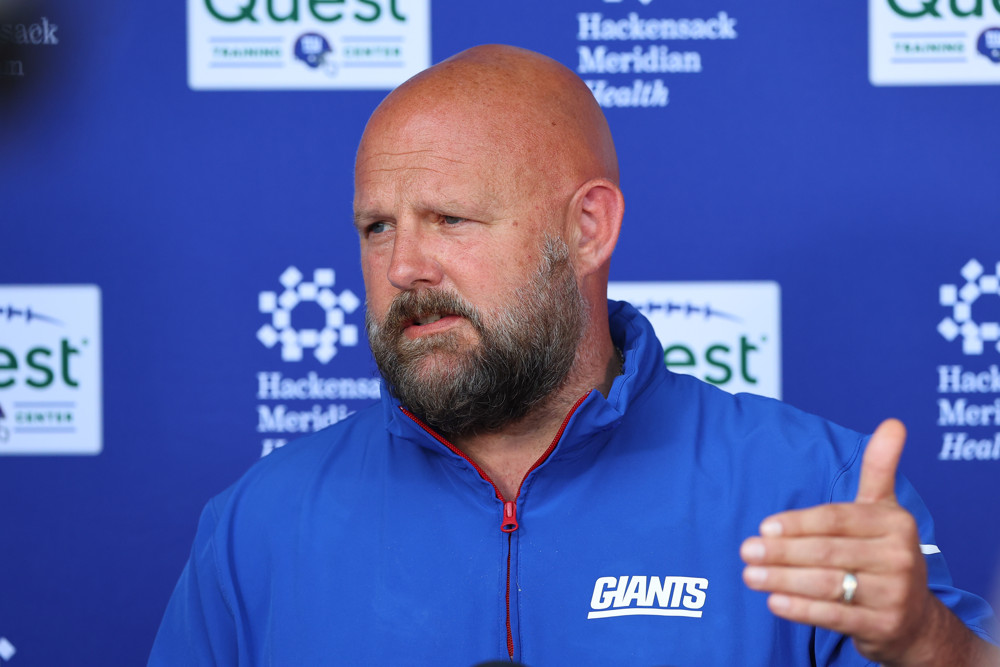

When I set out the key traits that I believed the Chargers should use as search parameters for their next offensive coordinator, the name that could satisfy the most was clearly Brian Daboll. The former Head Coach of the New York Giants is a strategically adaptable offensive play caller whose skills align closely with what the Chargers are seeking: a run-first, play-action-focused offense that maximizes efficiency, clarifies roles, and reduces QB over-exposure. Daboll can operate effectively within Harbaugh-style boundaries enhancing the run game while layering in efficient vertical and intermediate passing concepts. He is particularly strong in red-zone execution, third-down play design, and situational adaptability, making him a natural fit for a roster built around a downhill running attack, Justin Herbert’s passing strengths, and complementary weapons like Ladd McConkey and Omarion Hampton.
He is a coach with a clear track record of play-calling at a high level, providing answers to both pressure and negative game scripts, and his staff has elevated players across all positions. Additionally, at 50 years old, he is experienced enough to stay ahead of the curve in terms of the problems that modern defenses present. Daboll has worked across multiple systems under some of the best head coaches the game has ever seen. Despite those stops at illustrious football factories, his scheme is his own, and it is rooted in the same base principles that Harbaugh has been trying to champion over the past two seasons.
“Protect the quarterback, beef up the run game, play‑action pass and the drop‑back game. We’re going to try to get it as great as we can. Be a balanced type of football team. Always protect the football. That’s where it starts.”
Jim Harbaugh on his vision for the Chargers’ offense
Brian Daboll stands out for this role because the strengths of his background fit within Jim Harbaugh’s offensive core principles. His talent as a play designer has, at its peak, been in the elite tier of the league however I think a more prevalent reason for his fit into the Chargers, is where he is in his career. This isn’t a hot-shot coordinator riding on the vanguard of a new offensive sub-branch. Daboll learned his craft from some of the best football minds in history but he has also suffered on his own. With his experience as a Head Coach I feel like he would be humble enough to want to deliver Harbaugh’s vision for an offense rather than requiring control over them towards his own identity.
Coaching Resume
- William & Mary: Volunteer Assistant (1997)
- Michigan State: Graduate Assistant (1998–1999)
- New England Patriots:
- Defensive Assistant (2000-2001)
- Wide Receivers Coach (2002-2006)
- New York Jets: Quarterbacks coach (2007-2008)
- Cleveland Browns: Offensive Coordinator (2009-2010)
- Miami Dolphins: Offensive Coordinator (2011)
- Kansas City Chiefs: Offensive Coordinator (2012)
- New England Patriots: Tight Ends Coach (2013-2016)
- Alabama: Offensive Coordinator & Quarterbacks coach (2017)
- Buffalo Bills: Offensive Coordinator (2018-2021)
- New York Giants: Head Coach (2022-2025)
Daboll’s Evolution
At each stop along his long career, Daboll has picked up pieces of different systems and, as any accomplished coach should do, integrate them into his own. You can see that each of his major destinations imprinted on his game when you turn on the tape. He learnt discipline through the Erhardt-Perkins scheme during his time under Bill Belichick at the Patriots. Under Nick Saban (at both Michigan State and Alabama) he would have seen how they made their concepts very quarterback friendly.
Even when Daboll was done being a student and became a leader himself, he didn’t stop learning. Whilst developing Josh Allen he showed real growth in terms of how he sequences plays. During this time he had to adapt his concepts to attack leverages rather than zone or man as pattern-match filtered up from the college ranks. Then when the Giants’ roster strategies failed him, he showed real constraint without the elite talent he had found success with before.
Personality
Brian Daboll is known as a demanding but relational coach who is considered to be high-energy, blunt, and highly competitive. This does not however mean he is distant or authoritarian in fact, before his stint at the Giants, players seemed to gravitate towards him in a way that attracted the Chargers before they ultimately chose Brandon Staley instead. Daboll coaches hard, expects accountability, and is comfortable being confrontational in the moment, especially with quarterbacks. Players generally describe him as invested and communicative rather than a pure authoritarian. His communication style leans toward honest feedback and emotional buy-in, he does not give passive instruction.
In practice and meetings, Daboll appears to be detail-oriented and intense, but he also empowers players to understand why concepts work, particularly quarterbacks and skill players. He values confidence and decisiveness over perfection, which can accelerate development for the right personalities but may be challenging for players who struggle with fast-paced communication or direct critique. His pre-draft interview with Jaxson Dart stands out to me as a moment that showed his character and pure love of football.
Temperament Concerns
When people talk about Brian Daboll’s temperament, it usually starts with his energy. He’s vocal, animated, and demanding, and he coaches with a sense of urgency that’s always visible on the sideline and in meetings. He believes in direct feedback, immediate correction, and keeping players mentally engaged at all times. That intensity has clearly worked for him in the past, but it also means his success depends heavily on the environment he’s working in and how well roles and communication styles are aligned.
With Jim Harbaugh, the relationship would hinge less on personality and more on structure. Harbaugh runs programs with a strong sense of hierarchy and identity, and he prefers clarity over collaboration-by-committee. Daboll is used to having real input into offensive problem-solving, especially in-game, so things work best when expectations are clearly set from the start. If Daboll is positioned as the coach responsible for sharpening and executing the offensive plan rather than redefining it, their shared emphasis on toughness, accountability, and competitive edge gives the pairing a natural foundation. Without that clarity, moments where Daboll wants to press tempo or turn to aggression could create tension with Harbaugh’s preference for control and physical dominance.
One place where Daboll’s personality can be seen as a negative is on the sideline when things are going wrong. He showed a lack of emotional control in multiple spots in the 2025 season, including storming into the blue tent to seemingly try to manipulate the medical team to clear his quarterback, a move which was completely unacceptable in my eyes, and he was rightly punished for it. This moment spoke to how he handles pressure, but I think that multiple factors can either be negated or will not be relevant here. Firstly, he won’t be the head coach, so there isn’t as much on his shoulders. Also, he isn’t going to be on a team that is flailing towards another top 5 draft pick with the weight of the New York media on his shoulders. Additionally, I think Harbaugh’s preference for the game-day operation could mean this hurdle is cleared in stride.
Harbaugh has preferred to have his offensive coordinators stay up in the booth (Greg Roman, Pep Hamilton), which could address the concerns around Daboll’s demeanor on the sidelines. Brian called plays from the booth when this was first allowed in 2018 however, he reverted back to the on-field position as his rookie quarterback struggled later in the season. He has seen the pros and cons of both perspective, but if he were to return as an offensive coordinator under an established head coach, I’d expect him to move upstairs.
“There’s different things – you’re less emotional when you’re upstairs, more calm environment, you can maybe see part of the field a little bit better.”
Brian Daboll, on calling plays from the booth
The more delicate fit is with Justin Herbert. Herbert is not a quarterback who needs emotional fuel or constant vocal stimulation; he plays his best football when information is clean, communication is calm, and decision-making is uncluttered. Daboll’s intensity isn’t a problem in itself, but if it carries over unchecked into game situations, it risks creating mental noise rather than clarity. For the partnership to work, Daboll would need to tailor his approach, keeping his coaching precise and measured, especially on the sideline. When his directness is paired with restraint, it can support Herbert’s strengths. When it isn’t, it risks working against them.
That said, I think Daboll’s personality can bring out the best in Herbert in tough moments, such as the playoffs, where he has clearly struggled with the mental fortitude to bear the pressure that comes with the quarterback position. I believe that, within the three playoff losses, the Chargers have come up against the ceiling of the supportive role, which lets Herbert forge his own path. They could therefore stand to have a more direct approach with him. This doesn’t necessarily use forceful measures to push him beyond where he can be himself, instead it should look to steer him towards a more narrow pathway. Herbert’s personality seems to me to be one that would prefer instructive direction than license to be creative.
Players he will improve
Justin Herbert
Despite some concerns about the compatibility of their personalities, I strongly feel like Daboll will elevate Herbert’s game due to his extensive experience as a quarterback’s coach. He has one of the most clear-cut examples of player development in NFL history as he helped turn Josh Allen from a raw prospect into an MVP-winning quarterback.
Brian Daboll’s work with Josh Allen was not centered on rebuilding mechanics, but on refining them at the margins. The emphasis was on stripping away unnecessary movement, reinforcing repeatable footwork and timing, and tightening the connection between lower-body mechanics and release. Rather than chasing visible changes, the process focused on small, deliberate adjustments made consistently over time, allowing efficiency and control to improve without compromising natural arm talent or aggressiveness.
“You have to do a good job as a coach of taking stuff out and making sure they understand the boulders and then working on the pebbles… his footwork, drop mechanics, throwing mechanics, his read progressions.”
Daboll summarizing Allen’s developmental arc
That same refinement-oriented approach fits a quarterback like Justin Herbert. Herbert’s baseline mechanics and arm strength already place him among the league’s best; the opportunity lies in expanding command rather than correction. Daboll’s history suggests he will focus on improving Herbert’s throttle control, manipulating ball flight, and sharpening situational touch so that velocity becomes a choice rather than a default. Those marginal gains, accumulated over time, are often what elevate a great quarterback into the elite tier without altering what makes him special.
Another factor to consider in terms of Herbert’s development is that Brian Daboll gives his quarterbacks a lot of autonomy at the line of scrimmage. He will need to be able to adjust pass protections and call audibles at a high level in order to master Daboll’s scheme. This is something that Herbert lacks in his game right now, so I am all for putting more on his plate as he is clearly capable on a cerebral level.
Ladd McConkey
Brian Daboll has consistently increased the impact of high-quality slot receivers by designing game plans that make them central to the offense rather than secondary options. In Buffalo and New York, players like Cole Beasley and Wan’Dale Robinson were used as frequent, clearly defined targets, running a mix of quick routes, intermediate crossers, and run-action patterns that forced defenses to respect them on every play.
Ladd McConkey has expressed a desire to be more involved and make consistent plays in the upcoming season. Daboll’s approach could help him achieve that by creating a route tree that leverages his quickness and precision, using formations and motion to create isolation opportunities and high-percentage targets. By turning McConkey into a go-to slot presence, as he did with Beasley and Robinson, the offense gains a reliable chain-mover, a natural extension of the play-action scheme, and a player defenses have to account for on every down.
The Entire Offensive Line
For too long, the Chargers’ offensive line has been their Achilles heel, and this offseason hinges entirely on fixing this position group. Obviously, getting two All-Pro caliber Tackles back will go some way to addressing the talent gap, but there are three positions between them that any incoming offensive coordinator will need to drastically improve. Now there is narrative that Daboll has struggled to develop his offensive line over the past 5 seasons in New York. This presumption is based on sound logic if you look at the surface numbers but when you add context, it becomes clear why that he deserves some leeway.
Daboll inherited a mess of an offensive line that ranked 31st or worse in every metric available in 2021, so to correct this his new front office went all out to ensure both he and fourth-year quarterback Daniel Jones had every shot at re-inventing their offense. In the Spring of 2022, following Daboll’s appointment, the G-Men added three free agents in Mark Glowinski, Jon Feliciano and Max Garcia. Then they doubled down by drafting Evan Neal, Joshua Ezeudu and Marcus McKethan one month later. Not one of these six additions played a single snap for an NFL team in 2025 and most of them were off the team within two seasons. The front office absolutely whiffed on every single aspect of their over-investment at a critical position and it took them a long time to recover. This has even more relevance when you realize that this haul was stuck between David Gettlemen’s last group of acquisitions and Joe Schoen’s first one as the Giants changed GM not long before the start of Free Agency.
The Giants’ Offensive Line PFF Grades by Season Under Brian Daboll:
- 2022: 18th
- 2023: 29th
- 2024: 25th
- 2025: 9th
Since that disastrous off-season, Daboll was shackled with working with cast off free agents to recoup some of the lost resources but in 2025, after much experimentation, the New York Giants saw a dramatic turnaround. Their maligned offensive line climbed into the top 10 in many end of season rankings including 9th in their overall PFF grade and a lofty 4th in pass block efficiency. This transformation came under the watch of Daboll and his Offensive Line coach Carmen Bricillo, who could be available should Daboll be the man the Charger choose to call their offense. The Giants have said Bricillo is under contract for the 2026 season but if Daboll was to offer him the Run Coordinator role at the Bolts, I believe he’d have to strongly think about the opportunity that presents.
Daboll’s Scheme
Brian Daboll’s offensive scheme is built on an Erhardt–Perkins foundation that prioritizes concept-based installation, formation multiplicity, and personnel interchangeability. The passing game is structured around mirrored and modular route concepts which can be run from multiple alignments with minimal terminology changes. Daboll uses pre-snap motion, condensed splits and varied releases to force coverage declarations and manipulate second-level defenders. Option routes and coverage-adjusted stems are central, giving receivers and tight ends autonomy to convert routes based on leverage which is something that will suit the Bolts. His protection structures commonly feature half-slide principles with defined hot and sight adjustments, allowing the quarterback to maintain rhythm while preserving vertical stress through play-action and deep-intermediate concepts.
The run game integrates multiple run concepts which are selected to match personnel strengths and defensive structure. Daboll frequently deploys condensed formations and shifting surfaces to alter run fits and create favorable blocking angles. The run and pass games are tightly married through play-action, bootleg, and RPO elements, repeatedly placing linebackers and apex defenders in conflict between run fits and intermediate windows. Daboll’s Quarterback usage normally expands the offensive structure through designed runs, zone-read mechanics, and movement throws, stressing edge defenders and enhancing the offense’s numerical and spatial advantages. The scheme as a whole emphasizes adaptability, post-snap leverage exploitation, and quarterback decision-making within a streamlined conceptual framework.
Core Philosophies
- Situational excellence (3rd down, red zone, 2-minute) over yardage accumulation
- Run game dictates defensive structure
- Pass game punishes over commitment; it does not replace the run
- Reduce negative plays to stay ahead of the chains.
“We’re really focused on no. 1 situational awareness. We’re still working on that to this day. Doing whatever we’ve got to do to keep us in positive percentages.”
Brian Daboll on getting Josh Allen to play with more contextual control
Personnel
- Base: 11 and 12 personnel with a preference for balanced formations
- Heavy use of condensed looks
- Purposeful use of varied motions
- Uses Empty as a successful counter
- Tight ends and slot receivers prioritized over perimeter isolation specialists
Tendencies
- 52–55% run in neutral situations
- Pass volume driven by game state rather than script
- Flexible PROE +6.8% at Buffalo but -3.8% with New York
- Passing efficiency prioritized over volume
- RPO has been a consistent feature for Daboll but I do not expect it to be with the Bolts
- 20-30% Play Action Rate, with an increasing rate once his quarterbacks were established in his scheme
Run Game Style
- Daboll runs a heavy mix of Inside zone, Split zone, Duo, Pin-pull, and Power.
- Daboll reinvented his playbook between roles; shifting from Zone in his Coordinator days to Gap as a Head Coach
- Recently he has been running more Power and Counter as his primary concepts as he looked to expose the middle of field like he was able to do against the Chargers in their Week 5 victory.
- His running style will suit Omarion Hampton and he prefers to use a bell-cow back than a committee which could be key in developing the Chargers’ lead back into his second season.
Favorite Passing Concepts
- Play-action deep overs (Yankee, Over + Post)
- Mills (Post + Dig) against single-high looks
- Flood concepts off boot action
- Slot Option routes vs zone
- Seams and Glance routes from condensed splits
Contextual Flexibility
- Negative game scripts
- Increases tempo and QB-driven execution
- Uses quick-game concepts and situational aggression
- Raises reliance on protection and QB processing
- Blitz-heavy teams
- Uses condensed formations and quick throws to reduce edge pressure
- Incorporates RBs and TEs as options to replace the blitzers
- Most effective against predictable blitzes; less adaptable vs late or disguised pressure
Final Word
Daboll’s added-value stems from his handling of sequencing, situational design, and leveraging defensive reactions. That’s a methodology which contrasts the high-volume passing or schematic novelty of the modern game that Harbaugh has typically steered away from. Therefore Daboll’s profile as a coordinator fits well with Harbaugh-style offense where the ground game establishes leverage control and the passing game is tasked with capitalizing on it efficiently.
The impact that Daboll would have on the Chargers offense would be more likely show up in play-action structure, red-zone efficiency, and third-down clarity rather than raw production spikes. His offenses perform best when asked to solve specific problems: how to punish loaded boxes, manufacture favorable matchups, and simplify reads in high-leverage moments. These are all components that the Chargers should be searching for.
Daboll represents a practical modernization of the Chargers offense under Jim Harbaugh; preserving physical identity while unlocking efficiency, balance, and matchup advantages. That is the exact profile the search committee should be looking for to elevate this talented roster above Wildcard Round exits and push them closer to their ultimate goal of winning a Super Bowl.































Really great article and I’ve got some summer reading to do with the E-P scheme.
Ryan,
From a pure X and O scheme, I love Brian Daboll’s offense. I live in NYC area so I have been watching this offense up close for 4 years. He always seemed to be able to scheme guys open and was able to routinely get the ball to Nabers. He knows how to get the ball to his playmakers.
My biggest issue is with his attitude and personality. Away from the field when I have seen him interviewed in Pre season or during OTA’s he is a very congenial and quite funny. He can take a joke as well, but when the lights got bright he became quite the opposite. Nasty and combative. Granted, the situation here was pressure packed especially after getting to the divisional round and coach of the year honors in year one with the NYG. I am not sure if his intense traits will be a boon or detriment with Herbert, who seems like a quiet, fiery competitor. Daboll has had no issue in the past getting into his QB’s face when mistakes are made.
He has worked under Saban and Belicheck, so from what I saw he has molded himself from that approach of a vocal, no nonsense, leader as opposed to Harbaugh’s underlying competitive fire behind constant positivity.
I think from a pure scheme perspective, he is fantastic. I just wonder if the personality and approach would jive with Harbaugh and Herbert? Harbaugh said in his presser that he is open to new schemes and philosophies that are rooted in his core beliefs, but at the end of the day, I wonder how far a bridge that is?
In regards to Herbert and his personality, I’ll just run through his coaches since HS.
Sheldon HC – Marty Johnson – Teacher of the game who coached a lot of guys above their talent level from being smart QB’s, not just guys with an arm.
Oregon HC – Mark Helfrich – Very similar to Coach Johnson in that he was a cerebral teacher and not a hot-head personality. Had he started Herbert Day 1 he may have kept his job.
Oregon HC – Willie Taggart – I bet Willie Taggart wishes he never left Eugene because he never had it so good. Not a teacher of the game and wasn’t integral to the Offensive coaching/play-calling but he hired a good staff.
Oregon HC – Mario Cristobal – After all these years, Mario has finally (seemingly?) gotten out of the way of his Offensive Coordinators. Running the Pistol without ever running the QB and trusting him to protect himself was just dumb. Easily the most similar in regards to Daboll if you want to talk intensity meter, but I don’t think Daboll really nears Mario at Peak-Mario.
I used to talk about that period of Oregon coaches as being like the Revenge of the Nerds movie and their main groups: The Nerds and Jocks.
Helfrich and Mario represented the extreme ends of that and I really believe that in the middle is that needed balance to succeed. All of that I guess to say that Justin can absolutely handle the worst of Daboll as long as Daboll is holding up his end of the bargain with the scheme/playcalling.
In the past Harbaugh really showed his ass on the sidelines and it was a concern I voiced here. To date we haven’t seen that emotionally overwrought Harbaugh and I’m glad.
Like you, I like Daboll the coordinator. I am concerned about the mix of these two personalities. That’s intended to be a concern, not a judgment.
Good stuff Ryan! I was already leaning towards Daboll as my favorite candidate for OC and now I’m fully on the Daboll or bust team.
I hope that his Sideline antics of this past season scares off teams and diminish his chances of getting a HC job again this quickly. If he realizes his only option is an OC job then the Chargers have to be the best opportunity out there.