


The Signpost Pick:
What Genesis Smith’s Acquisition
Tells Us About O’Leary’s Defense
Most people looked at the 131st pick and saw a tackling problem the Chargers were seemingly willing to overlook. The more interesting question is what the pick signals about where the next iteration of the defense is going.
Draft analysis has a tendency to reduce every pick to a simple transaction: here is what we gave up, here is the player’s grade, here is the risk. Applied to Genesis Smith, that transaction reads as a coverage-first safety whose tackling numbers were bad enough to cost him two rounds of draft capital. The Chargers saw the same tape everyone else did and took him anyway at 131. Understanding why they wanted Smith’s talents in particular requires looking past the player and at the role, because the pick is less a statement about his individual ceiling and more a statement about the kind of defense Chris O’Leary is building.
01How the Midseason Trade Changed the Chargers’ Money-Down Defense
During his time with the Chargers, Jesse Minter used three-high safety shells as a situational tool on later downs, rotating the middle safety down into the hole to take away crossing routes and short in-breakers before they could develop. On paper the concept was sound. In practice, the execution depended almost entirely on having the right player in that middle position, and the 2025 roster showed very clearly what that player actually needs to do.
Alohi Gilman filled that role effectively early in the season. He could hold his alignment in the shell without tipping his rotation, he was decisive in his downhill trigger, and his processing speed allowed him to threaten the hole credibly enough to affect quarterback timing even on plays where he never made the tackle. After Gilman was traded to Baltimore, the Chargers rotated Tony Jefferson and RJ Mickens through the role. Both could come downhill from it with reasonable authority; the problem revealed itself in the other direction. When a dig route or in-breaking concept pushed them to climb back up and compress the throwing window from inside the hashes, neither had the vertical range to get there in time. The space between the hash marks became progressively easier to attack as the season went on.
| Package | Period | Usage | EPA / Play | Success Rate | |
|---|---|---|---|---|---|
| Dime (6 DBs) | |||||
| Dime | Wks 1–5 | 83.7% | +0.029 | 38.9% | |
| Dime | Wk 6+ | 63.3% | +0.281 | 45.6% | |
| Nickel (5 DBs) | |||||
| Nickel | Wks 1–5 | 16.3% | +0.476 | 70.6% | |
| Nickel | Wk 6+ | 36.7% | −0.528 | 30.3% | |
Nickel usage more than doubled after Week 5 as the coaching staff searched for workable alternatives to Dime following the Gilman trade. The EPA/Play swing of 1.00 point across the two Nickel periods tells the story clearly: the package that had been quietly efficient became a liability once the player making the three-high shell function was gone.
The numbers from the 2024 season make the problem concrete. Through the first five weeks the Chargers were running Dime on more than four fifths of third-down passing situations, with Nickel used sparingly but to devastating effect when it appeared: a 70.6 percent success rate and +0.476 EPA/play. From Week 6 onwards, with Gilman gone, Nickel usage more than doubled as the roster adjusted, and the results were stark. The Dime package actually improved as the season went on, which indicates the personnel around the middle safety role remained competent. It was specifically the Nickel that collapsed to a 30.3 percent success rate and -0.528 EPA/play, pointing toward a defense forced into sub-optimal groupings in passing situations because the player making the three-high shell work in the middle was no longer there.
Three plays from the 2025 Chargers season showing the three-high shell with the middle safety dropping into the hole.
Jesse Minter brought the three-high concept with him from his Michigan scheme but now Chris O’Leary and his staff appear to be looking to take this late-down concept and expand it into a schematic mechanism to mold Minter’s base principles into his own vision for the defense. This would require a very specific athletic profile the Chargers were still missing before the draft: a safety who can play with genuine two-directional range between the hashes, threatening the downhill fit against the run and the quick in-breaker while retaining enough vertical burst to climb back up and close the inside throwing window on deeper breaking routes. That is not a common skill set, because most safeties at this level are built to do one convincingly as either a free or strong safety. The Chargers spent the back half of last season discovering what the absence of the other direction costs them.
02Why Smith Fits the Role
The coverage profile that makes Genesis Smith worth a fourth-round pick is not just his ability to play center field, though he does that well. It is the range he shows when operating between the hashes at variable depths. Watching his Arizona tape, what stands out is a safety who can play the role from a deep perch and still close on a route breaking to the inside of the numbers, or sit at linebacker depth and climb vertically to contest a dig before the quarterback has finished his drop. That two-directional flexibility is precisely what Gilman offered, even if his athleticism placed limits on it, and what Jefferson and Mickens could not replicate in the second half of the season.
Smith demonstrating vertical range between the hashes. Note the ability to threaten downhill on the short in-breaker and then redirect to contest the dig route. To climb that far up to squeeze the throwing window shut is impressive.
By the end of the 2025 season, particularly the last two games against Baylor and Arizona State, Smith had become genuinely comfortable playing from inside the hashes outwards at any depth. He could sit in the hole at linebacker depth and look natural, or drop to a deep perch and still be a functional threat to the underneath picture. The remaining angle issues at that point in the season were almost entirely confined to plays that asked him to work from outside the hashes inward, where his read keys were still unreliable and his tracking angles broke down against misdirection. The version of this role the Chargers are building asks him to operate predominantly from the inside out, which maps directly onto where his tape was already at its best.
03The Aztec Role
The Aztec safety is a creation of Rocky Long, who first installed the 3-3-5 at New Mexico in 1998 before refining it across two decades at San Diego State. The name comes from SDSU’s team identity, and Danny Gonzales has been connected to it almost as long as the scheme has existed: he was a player on Long’s first New Mexico team and has spent the bulk of his coaching career running variations of the same system. The position sits at the intersection of free safety, nickel and linebacker, aligned in the middle of the field between the stacked linebacker core and the deep third. Its defining feature is deliberate pre-snap ambiguity. The defense presents a one-high shell before the snap, and the Aztec’s post-snap assignment, whether that is dropping into the hole as a robber, climbing into deep coverage or triggering into the run fit, is determined entirely by what he reads from the mesh point and the run-pass indicator. The warrior safeties outside rotate to fill the coverage behind him.

What makes the role genuinely difficult is that those read triggers are self-generated rather than call-dependent. A conventional free safety knows his run/pass assignment before the snap; the Aztec does not. He has to hold his alignment without telegraphing his intention, process the quarterback, the run-fit picture and the route distribution simultaneously, and then commit with enough authority to either set the cutback edge against the run or take away the crossing game before the ball arrives.
The diagrams below show how the Aztec role functions structurally. Pre-snap, he presents in center field as a conventional free safety. Post-snap, the assignment is determined by his own read of the mesh point: he either drops into the hole as a robber, triggers into the run fit, or climbs into the deep middle third as the warriors rotate outside behind him.
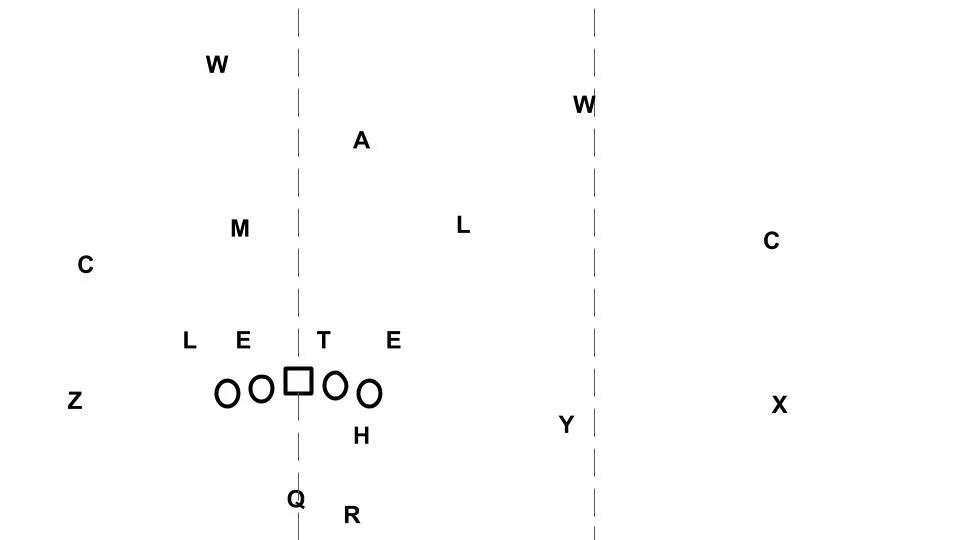

The scheme’s spill mechanics compound the demand of the role. The three-man front and linebacker stack are designed to force ball-carriers laterally, so the Aztec’s run-fit responsibility requires him to fill from the inside-out after the blocks do their work rather than reading frontside. A player who keys the quarterback’s eyes rather than his run keys will be late to both assignments.
An example of spill defensive mechanics within the 3-3-5 scheme and how the front forces ball-carriers laterally to set up the Aztec’s inside-out run fit.
There is a downstream benefit to this that points toward why the Chargers may not have invested heavily in the linebacker group this offseason. When the middle safety is a credible threat to the inside of the field at multiple depths, the linebackers in front of him are working a simpler picture. Their run-fit responsibilities narrow because the hole player behind them is genuinely taking the crossing game away rather than only threatening it. A linebacker working inside-out against zone runs with a reliable Aztec player over the top has cleaner angles and fewer conflicting reads than one who has to account for the middle of the field himself. O’Leary may well have decided that the linebacker group he already has is sufficient for what he is asking them to do, provided the third safety behind them is the right one. This can enable the linebackers to play more aggressively too. O’Leary liked to send off-ball pressures and one way he could look to introduce chaos on late downs would be to vacate the linebacker level entirely, drop off rushers from the line, and use Smith’s unique skills to patrol the middle of the field that the dropping linemen would not be able to reach.
04How O’Leary Bridges Two Philosophies
The question that has hung over O’Leary’s appointment since January is how he reconciles his preference for single-high aggression with the two-high foundations that made Minter’s Chargers defense one of the best in football. Tearing up what Minter built would be unnecessary and probably counterproductive. Arriving as a pale imitation of it would waste the fresh perspective O’Leary specifically brings.
His Western Michigan tape offers some insight as it should look familiar to those who have studied Jesse Minter’s scheme. However Chris O’Leary is his own man. He used three-high shells at WMU not as a purely defensive alignment but as a platform to launch his various Cover 2 coverages, rotating the safeties in multiple directions while the outside defenders dropped into the underneath zones. Against a single-high defense, Cover 2 is a relatively easy concept for a quarterback to identify and attack because the pre-snap picture tells him where the seam is. From a three-high shell, the rotation is much harder to anticipate, and the quarterback who has been processing a two-high coverage has to recalibrate under pressure as the coverage picture changes post-snap.
Western Michigan rotating from a three-high shell into Middle Hole coverage.
This concept could be O’Leary’s bridge that allows the Minter two-high vocabulary to stay intact as a base, providing the structural familiarity the Chargers’ secondary has already learned. O’Leary then uses the three-high shell as the delivery mechanism for both his aggressive single-high concepts and for Tampa 2, so the same pre-snap picture can produce meaningfully different post-snap outcomes depending on the call. A quarterback who has learned to read the Chargers’ two-high shell and identify the Tampa 2 rotation now faces a defense whose three-high shell could rotate into Tampa 2, collapse into a single-high run fit, or hold in a traditional two-high structure. The middle safety’s range is the variable that makes all three outcomes credible simultaneously.
Related Why Chris O’Leary is Not Just Jesse Minter 2.0 →“The same pre-snap picture producing three different post-snap outcomes is only credible if the middle safety can actually execute all three. Smith is the player who makes the deception real.”
Stormcloud analysis, 2026 Draft05Why the 3-3-5 Scheme Contributed to Smith’s Tackling Troubles
The tackling numbers that defined most of Smith’s draft coverage deserve a more considered reading than they received. His 20.1 percent missed tackle rate is eye-catching in all the wrong ways, but a meaningful portion of those misses look different in context than they do in a spreadsheet. Tackling statistics are useful but they are limited in explaining the root causes. Chris O’Leary and Steve Clinkscale will have stated their case for fixing his issues in order to draft him early on Day 3 and there is a case for optimism to be found within the schematic leverages he was working with.
Smith in lateral pursuit situations.
As discussed in Section 03, the 3-3-5 is a spill defense. The design intention of the front is to kick ball-carriers outside the blocks rather than allow them to press vertically, and the Aztec’s run-fit responsibility asks him to work outside those same blocks to set the cutback edge. A safety who aggressively pursues outside a blocker in that structure is executing the assignment correctly, not avoiding contact. To an eye unfamiliar with spill mechanics, that movement can read as a player backing out of a tackle when he is actually doing his job. Some of what accumulated in Smith’s missed tackle numbers was genuine technique breakdown and poor timing; however a good deal of it was the appearance of avoidance produced by correct spill execution.
What the tape does not show is a player unwilling to make contact. Smith was unafraid to commit at linebacker depth against bigger ball-carriers throughout the season, and his attitude in those situations was not a question mark for evaluators who watched him closely. The angle errors that remained by the end of the season were concentrated in outside-in situations where his tracking keys were still unreliable, not in the between-the-hashes work that his NFL role will primarily demand.
Smith committing at linebacker depth against the run. The willingness to engage bigger ball-carriers from a compressed alignment was a consistent feature of his tape regardless of the angle issues that showed up in space.
The Chargers used both Lever and Spill mechanics in their Minus run fits last season, which means Smith has relevant exposure to both leverage frameworks across his two college systems. Having played under Duane Akina’s 4-2-5 and then Danny Gonzales’ 3-3-5, he arrives in Los Angeles with a broader range of run-fit experience than most players selected in his range. He also turned 21 in January, and four years in a consistent system with a coaching staff that has already demonstrated it knows how to develop defensive backs is a significant runway for a player whose athletic tools are genuine and whose scheme experience is already more directly relevant than almost anyone available in his draft range.
The Genesis Smith pick reads more convincingly as a window into O’Leary’s defensive vision than as a straightforward gamble on an imperfect prospect. The Chargers identified a specific gap in their 2025 scheme, a middle safety with genuine two-directional range between the hashes, and appear to have drafted the one player from this class whose tape was already moving toward an answer to that question. The role Smith is being built for demands inside-out range at variable depths, a credible downhill threat against the run and the quick in-breaker, and the vertical burst to climb back and compress the dig window. The 2025 Arizona tape, particularly toward the end of the season, showed those things developing in the right direction.
The broader signal, if this reading is correct, is that O’Leary has found a mechanism for bridging Minter’s two-high foundations with his own single-high aggression, and it runs through the three-high shell. Smith is the piece that could make the deception in that shell credible from early downs. Whether that projection proves out over the course of a full NFL season is a different question, but as a statement of schematic intent, the acquisition of someone of Smith’s profile points to a defense that will look to make life harder on those quarterbacks who think they have the beating of the Macdonald/Minter system.































Ryan,
Good stuff as usual. As a former safety, this was right in my wheelhouse and I understood it perfectly. I watched tape of Smith doing my draft scouting and I wrote up that he was a good CF type safety that had tacking concerns. He is willing, but the technique is bad and he doesn’t attack the player, he sort of corrals him waiting for help. This can be worked on, but sometimes the mentality can’t be changed. That would be my biggest concern. Some guys have that attitude and some don’t.
Also, on the first section of clips, the middle one is actually from Week 6 in 2024 against Denver. That just shows Minter was deploying this strategy in his first year as DC. I will be very interested to see how O’Leary plans to use Smith in the preseason and to see where he lands on the depth chart as training camp progresses. My thought is he will only be a sub package player at best to start unless he really cleans up his tackling. Ideally, I don’t think they would want him out there as a starter anytime soon if it can be avoided. I do think they view him as Molden’s replacement if he can be consistent since he is a good coverage player.
Your conclusion is what I figured too. Depth and maybe sub-package piece at best (at least in Year 1). After reading this though, I do wonder if part of the motivation was to ensure that they can use Derwin in the box even more and use him to blitz more. Especially if there’s an injury. I don’t have the specific data to back this up, but over the last few years, its felt like they want him in the box mostly, but as soon as there’s an inevitable injury they’ve had to move him back to a deep spot more often. He’s such an effective blitzer I’ve always wanted to see them lean into that a little more.
Maybe this helps with making sure he gets most of his snaps in the position they really want him to be.
Ryan, interesting stuff, but also confusing. You characterized the split as “2025 Regular Season · Weeks 1–8 vs. Post-Gilman Trade” but Gilman was traded after week 5. So it makes it seem like your splits aren’t valid, and thus your conclusions may not be valid.
You also don’t mention that Jefferson missed 4 of 12 games after Gilman was traded or that Molden missed 3 of 12 games. It seems like those things could have been contributing factors here.
I’m not sure that this invalidates the points of the article, but it would seem ideal if you adjusted and/or commented on these things.
Thanks for highlighting that mishap Tau. I’ve changed it now and to be honest the data is even more stark so it only strengthens the case.
I don’t see the injuries being a factor because none of them excelled in the role before or after the trade. Tony is great at coming downhill but he just doesn’t have the recovery speed to make the direction changes necessary to climb back up the hashes.
Also I watched Project Hail Mary yesterday and now when I read your username I can’t help but think about the star Tau Ceti, part of me hopes that’s what you were named after haha.
It is not as interesting as Tau Ceti.
I was in the Pi Kappa Phi fraternity in college. At NC State, the fraternity chapter was the 19th chapter of Pi Kappa Phi, which made it the Tau chapter. I was the 837th member of the chapter, which meant my “Tau number” was Tau 837. Perfect internet user name since no one would naturally understand this, making me anonymous.